
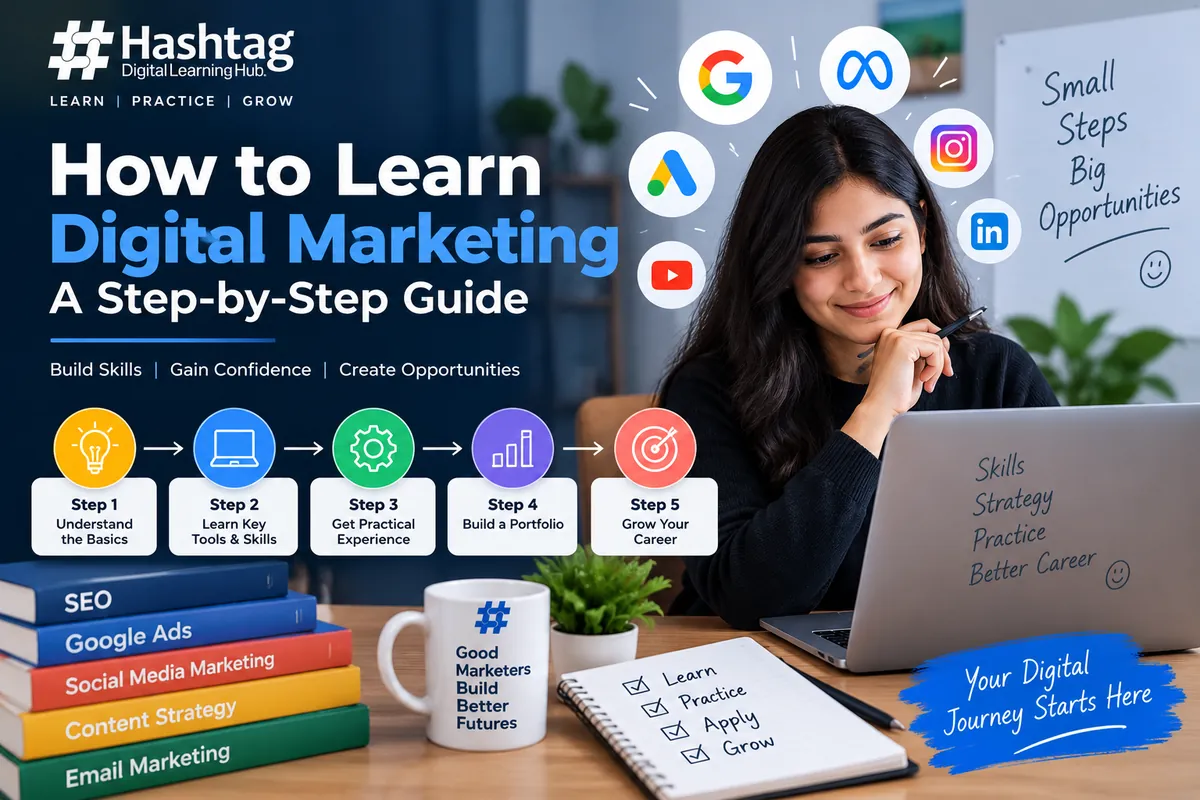
Digital marketing has become one of the most in-demand skills of this decade, and for good reason. Businesses of every size are shifting their budgets away from traditional advertising and into online channels, which means the demand for skilled marketers keeps growing. Whether you’re a student exploring career options, a working professional planning a switch, or a small business owner who wants to manage promotions in-house, learning this field can open doors that were not available a few years ago.
If you prefer learning with a mentor and live projects, see our structured digital marketing course in Dehradun, also available live online.
The challenge most beginners face isn’t a lack of resources — it’s the opposite. There is so much scattered information online that it becomes difficult to know where to start or what actually matters. Some people jump straight into running paid ads without understanding the basics, while others spend months on theory without ever touching a live campaign. Both approaches waste time.
This guide on how to learn digital marketing breaks the process down into a clear, practical roadmap. You’ll learn what to study first, which skills matter most in 2026, and how to gain real experience even before your first job. No fluff, just a structured path you can follow at your own pace.
Why Digital Marketing Is Worth Learning in 2026
Search behaviour has changed dramatically over the past two years. People no longer rely only on traditional search engines — they’re asking questions directly on AI tools like ChatGPT, Gemini, and Perplexity, and getting summarized answers instantly. This shift means marketers today need to understand not just classic SEO, but also how content gets picked up and cited by AI systems, a practice often called Generative Engine Optimisation (GEO).
At the same time, foundational skills like content marketing, social media management, and paid advertising remain just as relevant. What’s changed is the layer of AI-driven personalization and automation sitting on top of these fundamentals. Learning digital marketing now means combining timeless principles with newer, AI-aware strategies.
Step 1: Understand the Core Pillars of Digital Marketing
Before diving into any single specialization, it helps to get a bird’s-eye view of the field. Digital marketing typically includes:
- Search Engine Optimisation (SEO) – improving organic visibility on search engines and AI answer engines
- Content Marketing – creating blogs, videos, and resources that attract and retain an audience
- Social Media Marketing – building brand presence and engagement across platforms
- Pay-Per-Click (PPC) Advertising – running paid campaigns on Google, Meta, and other platforms
- Email Marketing – nurturing leads and retaining customers through targeted email campaigns
- Analytics and Data Interpretation – measuring what’s working and adjusting strategy accordingly
You don’t need to master all of these at once. Spend a week or two skimming through each pillar so you understand how they connect before picking a focus area.
Step 2: Build a Strong Foundation in SEO
SEO remains one of the most valuable skills a beginner can learn, and it’s evolving quickly. Beyond ranking on traditional search results, SEO now overlaps with how AI Overviews and generative engines choose which content to summarize or cite in their answers.
To build a solid foundation:
- Learn keyword research and search intent — understanding what a user actually wants when they type a query
- Study on-page SEO basics like title tags, meta descriptions, and header structure
- Understand technical SEO fundamentals such as site speed and mobile-friendliness
- Get familiar with E-E-A-T principles (Experience, Expertise, Authoritativeness, Trustworthiness), which search engines and AI systems both weigh heavily when deciding what content to trust
If you’re researching digital marketing courses, this is a good stage to enroll in one focused specifically on SEO fundamentals, since it gives you structured practice rather than scattered blog reading.
Step 3: Learn Content Marketing and Copywriting
Content is the backbone of almost every digital marketing strategy, from SEO to social media to email campaigns. Learning to write clearly and persuasively will make every other skill you pick up more effective.
Practical ways to build this skill:
- Start a personal blog or LinkedIn newsletter and publish consistently
- Study successful brand blogs in your niche and note what makes their content engaging
- Practice writing for different formats — short social captions, long-form guides, and email copy each require a different tone
Consistency matters more than perfection here. A few structured posts every week will teach you more than reading ten articles about writing theory.
Step 4: Get Hands-On With Paid Advertising
Once you’re comfortable with organic strategies, move into paid channels. Platforms like Google Ads and Meta Ads Manager offer free certifications and sandbox environments where you can practice without spending real money initially.
Focus on:
- Understanding campaign objectives (awareness, consideration, conversion)
- Learning audience targeting and segmentation
- Getting comfortable reading performance metrics like CTR, CPC, and ROAS
- Running small test campaigns with a limited budget on your own project or a volunteer client’s
This is also where many beginners discover whether they enjoy the analytical, testing-heavy side of marketing or prefer the creative, content-driven side.
Step 5: Master Analytics and Reporting
Every campaign you run needs to be measured, and this is where many self-taught marketers fall short. Learning tools like Google Analytics and basic reporting dashboards will set you apart early on.
Key areas to focus on:
- Setting up and reading traffic reports
- Understanding conversion tracking and goal setup
- Interpreting bounce rate, session duration, and user flow
- Translating data into actionable next steps for a campaign
Being able to explain why a campaign performed a certain way, using data, is a skill that consistently impresses hiring managers and clients alike.
Step 6: Choose a Specialization
Once you’ve got a working knowledge of all the core pillars, it’s time to specialize. Trying to be equally good at everything often leads to being average at all of it. Common specialization paths include:
- SEO specialist
- Social media strategist
- Performance marketer (paid ads focus)
- Content strategist
- Marketing analyst
Pick the area that matched your interest most during the earlier steps, and go deeper into advanced tactics, tools, and case studies specific to that field.
Step 7: Build a Portfolio Through Real Projects
Certificates are useful, but a portfolio of real work carries more weight with employers and clients. If you don’t have work experience yet, create it yourself:
- Manage social media for a local business or a friend’s startup, even for free initially
- Run a personal blog and track its organic growth over several months
- Offer to help a small business set up its first Google Ads campaign
- Document your process and results in a simple case study format
This kind of practical exposure is exactly what separates candidates who “know the theory” from those who can demonstrate real, applied experience — a distinction that matters both to human recruiters and to how credible your content appears to search engines.
Step 8: Stay Updated With Industry Changes
Digital marketing changes fast. Algorithm updates, new ad formats, and shifts in how people search (like the rise of AI-powered search) mean that what worked a year ago might not work today. Build habits like:
- Following credible industry blogs and official platform updates (Google Search Central, Meta Business blog)
- Joining marketing communities on LinkedIn or Reddit
- Setting aside time monthly to review new trends and tools
If you want structured, ongoing guidance rather than piecing information together yourself, exploring digital marketing training programs can help you stay current without falling behind on fast-moving changes.
Common Mistakes Beginners Should Avoid
- Jumping into paid ads too early without understanding targeting or messaging basics
- Ignoring analytics and judging success purely on likes or impressions
- Trying to learn everything at once instead of following a sequential path
- Skipping hands-on practice and relying only on video courses or reading
Avoiding these pitfalls alone can save months of wasted effort.
How Long Does It Take to Learn Digital Marketing?
Most beginners can grasp the fundamentals within two to three months of consistent study and practice. Reaching a job-ready or client-ready level of competence typically takes four to six months, depending on how much hands-on project work you do alongside the learning. Specializing further and building genuine expertise is an ongoing process that continues well beyond your first few campaigns.
Final Thoughts
Learning digital marketing doesn’t require rushing through every course you can find. A step-by-step approach — starting with the fundamentals, building hands-on experience, and gradually specializing — leads to far more durable skills than trying to absorb everything at once. Focus on consistency, apply what you learn on real projects as early as possible, and keep adapting as the industry evolves.
If you’re ready to move from learning the basics to applying them with expert guidance, explore the digital marketing courses available at hashtagdigitalmarketing.in and take the next step toward building a career in this field.
Frequently Asked Questions
1. Is digital marketing hard to learn for beginners? No, digital marketing is beginner-friendly since most core concepts are practical rather than technical. The learning curve depends more on consistency and hands-on practice than on prior technical knowledge.
2. Do I need a degree to work in digital marketing? A degree is not mandatory. Many successful marketers are self-taught or have completed certification courses. What matters more to employers is a demonstrated portfolio and measurable results.
3. Which digital marketing skill should I learn first? SEO and content marketing are good starting points since they form the foundation for most other channels, including social media and paid advertising.
4. Can I learn digital marketing for free? Yes, platforms like Google Skillshop, HubSpot Academy, and Meta Blueprint offer free certifications. However, structured paid courses can save time by organizing the learning path for you.
5. Is digital marketing still relevant with AI tools taking over search? Yes. AI has changed how people search and discover content, but it hasn’t replaced the need for strategy, creativity, and data interpretation — it has simply added a new layer that marketers need to understand alongside traditional skills.
Ready to Turn This Roadmap Into a Real Career?
Reading about digital marketing is one thing — building real, job-ready skills under expert guidance is another. If you’re serious about mastering SEO, content, paid ads, and analytics without wasting months on trial and error, hashtagdigitalmarketing.in can help you get there faster.
Enroll in our comprehensive digital marketing course today and get hands-on training, live projects, and mentorship from industry experts who’ve been through it themselves.
👉 Visit Hashtag Academy now to book your free career counselling session and take the first step toward your digital marketing career.