
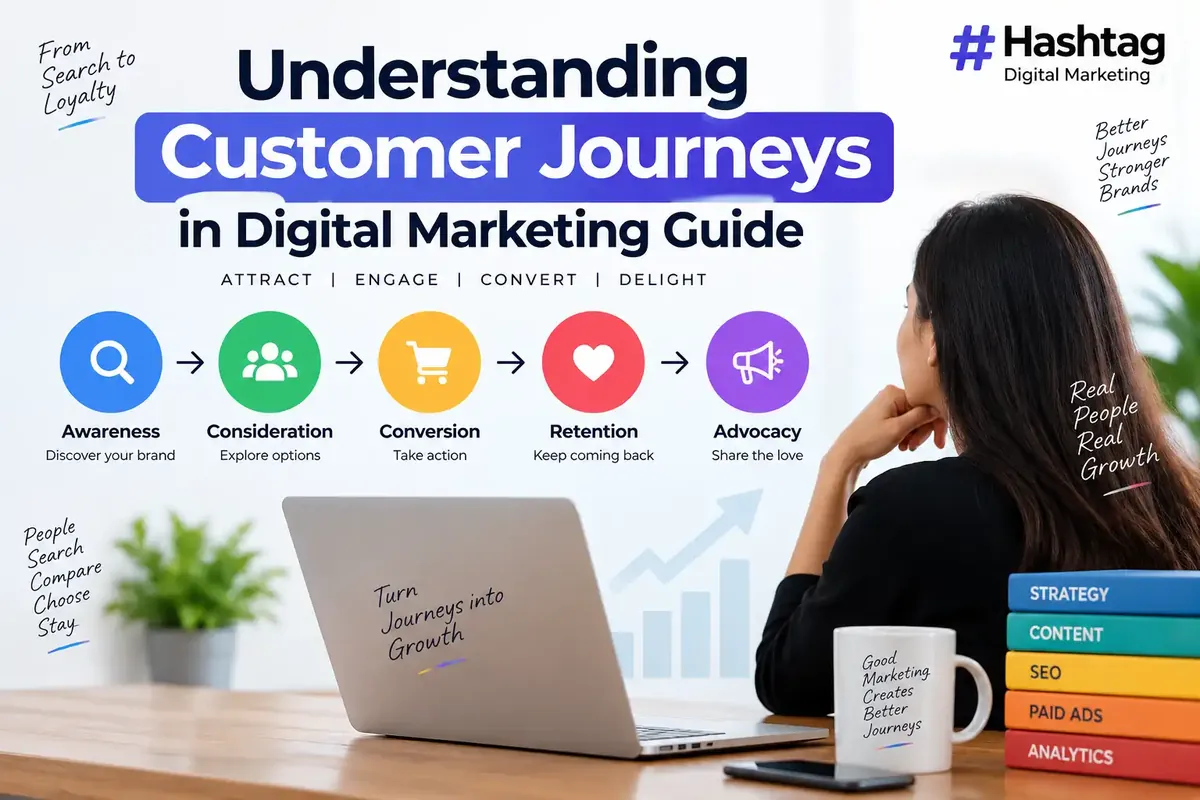
Every purchase, subscription, or sign-up today is the result of a series of small decisions made across multiple touchpoints. This is what marketers call the customer journey, and understanding it has become one of the most important skills in modern marketing. This Understanding Customer Journeys in Digital Marketing Guide breaks down how customers actually move from curiosity to conversion, and why brands that map this journey well consistently outperform those that don’t.
Search behaviour has changed dramatically in the last two years. With AI Overviews, conversational search, and zero-click results becoming common, customers now interact with brands across more channels than ever before, often without visiting a website at all in the early stages. This means marketers need a sharper, more data-informed view of how people research, compare, and decide.
In this guide, we’ll walk through each stage of the customer journey, explain how digital marketing strategy decisions should align with it, and share practical, real-world tips you can apply immediately. Whether you run an e-commerce store, a service business, or a B2B company, this framework applies to you.
What Is a Customer Journey in Digital Marketing?
A customer journey is the complete path a person takes from first discovering a brand to becoming a loyal, repeat customer. It includes every interaction, a search query, a social media post, a review, an email, a chatbot conversation, that shapes how someone feels about a business before they buy.
Unlike a simple sales funnel, which assumes a straight line from awareness to purchase, a real customer journey is rarely linear. People jump between stages, research on multiple devices, pause for weeks, and return later with new questions. Understanding this non-linear behaviour is central to building marketing that actually converts.
Why the Customer Journey Matters More in 2026
Search engines and AI assistants now summarise information before a user even clicks a link. This shifts a large part of the awareness stage into spaces brands don’t fully control. As a result:
- Buyers form opinions earlier, often from AI-generated summaries or social proof
- Trust signals like reviews, case studies, and expert content carry more weight
- Brands need visibility at every stage, not just at the point of purchase
Mapping the journey helps you identify where potential customers drop off and where your messaging needs to be stronger.
The Core Stages of the Customer Journey
Most journeys can be grouped into four broad stages. Each requires a different content and marketing approach.
1. Awareness Stage
This is when a person first realises they have a problem or need. They may not know your brand exists yet.
What works here:
- Educational blog content answering common questions
- Short-form video and social content that explains a problem simply
- SEO-optimised pages targeting informational search intent
Example: Someone searching “why is my website traffic dropping” isn’t ready to buy an SEO package. They want understanding first. Content that genuinely educates at this stage builds early trust.
2. Consideration Stage
Now the person knows their problem and is actively comparing solutions or providers.
What works here:
- Comparison guides and “best options” content
- Case studies showing real results
- Webinars, downloadable guides, or detailed how-to resources
This is also where a well-structured content marketing approach pays off, because buyers at this stage consume more detailed material before making a shortlist.
3. Decision Stage
The buyer is ready to choose. They’re looking for reassurance that they’re making the right call.
What works here:
- Clear pricing and service pages
- Testimonials, reviews, and trust badges
- Free consultations, demos, or trials
A small but important detail: decision-stage content should remove friction. If a potential customer has to search too hard for pricing or contact details, they often abandon the process altogether.
4. Retention and Advocacy Stage
The journey doesn’t end at purchase. Retaining customers and turning them into advocates is often more cost-effective than acquiring new ones.
What works here:
- Personalised email follow-ups and loyalty offers
- Requesting reviews and referrals at the right moment
- Ongoing value through newsletters or exclusive content
Businesses that treat this stage as an afterthought lose out on repeat revenue and organic word-of-mouth growth.
How to Map a Customer Journey Effectively
Journey mapping doesn’t need to be complicated. Here’s a practical approach:
- Identify your buyer personas – Understand who your typical customers are, their goals, and their pain points.
- List every touchpoint – Website, social media, email, search, reviews, customer support.
- Note the questions asked at each stage – This directly informs your content strategy.
- Track drop-off points using analytics – Tools like Google Analytics 4 and heatmaps reveal where users lose interest.
- Test and refine continuously – Journeys shift as consumer behaviour and platforms evolve.
A well-documented journey map becomes a shared reference for your entire marketing team, from SEO services planning to paid campaigns and email sequences.
Customer Journey and AI Search: What’s Changed
Generative Engine Optimisation, or GEO, has become essential alongside traditional SEO. AI-driven search tools now pull answers from multiple sources to generate summarised responses, which means your content needs to be structured for easy extraction and citation.
Practical steps to stay visible in AI search results:
- Answer questions directly and clearly near the top of your content
- Use structured headings that mirror how people phrase queries
- Back up claims with data, examples, or expert insight rather than vague statements
- Keep content genuinely useful rather than written purely to rank
Brands that publish clear, well-organised, experience-backed content tend to be favoured by both traditional search engines and AI summarisation tools, because both are ultimately trying to serve accurate, helpful answers to real questions.
Common Mistakes Businesses Make with Customer Journeys
- Treating all traffic the same: A first-time visitor and a returning customer need different messaging.
- Focusing only on the decision stage: Heavy investment in bottom-funnel ads without awareness content leads to a shallow pipeline.
- Ignoring post-purchase communication: Silence after a sale weakens loyalty and reduces referral potential.
- Not aligning content across channels: Inconsistent messaging between social media, email, and website confuses buyers.
Avoiding these mistakes often has a bigger impact on conversion rates than increasing ad spend.
Practical Tips to Improve Your Customer Journey Today
- Audit your website to ensure every stage of the journey has relevant content
- Use retargeting to re-engage visitors who didn’t convert on their first visit
- Add clear calls-to-action at every stage, not just on product pages
- Collect feedback from existing customers to understand real decision-making triggers
- Review analytics monthly to spot new patterns in behaviour
Small, consistent improvements to journey alignment tend to compound into meaningfully better conversion rates over time.
Final Thoughts
Understanding how your customers move from first contact to loyal advocate is no longer optional, it’s foundational to every marketing decision you make. From content creation to ad targeting to customer support, aligning your efforts with the real journey your audience takes leads to stronger relationships and better long-term results.
If you’re ready to build a customer journey strategy tailored to your business, the team at Hashtag Digital Marketing can help you map, optimise, and grow every stage of your funnel with data-backed strategies. Get in touch today to start turning more visitors into loyal customers.
Frequently Asked Questions
What is the difference between a customer journey and a sales funnel? A sales funnel is a simplified, linear model of conversion stages, while a customer journey reflects the actual, often non-linear path a person takes, including research, comparison, hesitation, and re-engagement before and after purchase.
How many stages does a typical customer journey have? Most frameworks use four core stages: awareness, consideration, decision, and retention or advocacy. Some businesses add sub-stages depending on the complexity of their sales cycle.
Why is customer journey mapping important for SEO? It helps you create content that matches search intent at each stage, from informational queries in the awareness phase to transactional queries in the decision phase, improving both rankings and conversion rates.
Does AI search change how customer journeys work? Yes. AI Overviews and conversational search tools influence the awareness and consideration stages earlier, meaning brands need visibility and trust signals before a user even visits their website.
How often should a customer journey map be updated? It’s good practice to review and update it at least twice a year, or whenever there’s a significant shift in customer behaviour, platform algorithms, or product offerings.
Ready to turn casual visitors into loyal customers?
At Hashtag Digital Marketing, we help businesses map every stage of their customer journey with data-driven strategies, smarter content, and result-focused campaigns. Whether you need better SEO visibility or stronger conversions, our team is ready to help. Contact us today and let’s grow your business together.