
Digital marketing has evolved into a core business function that directly impacts brand visibility, customer acquisition, and revenue growth across industries. Whether you plan to work in an agency, build a freelance career, or scale your own business, acquiring structured and practical knowledge is essential to stay competitive in the market.
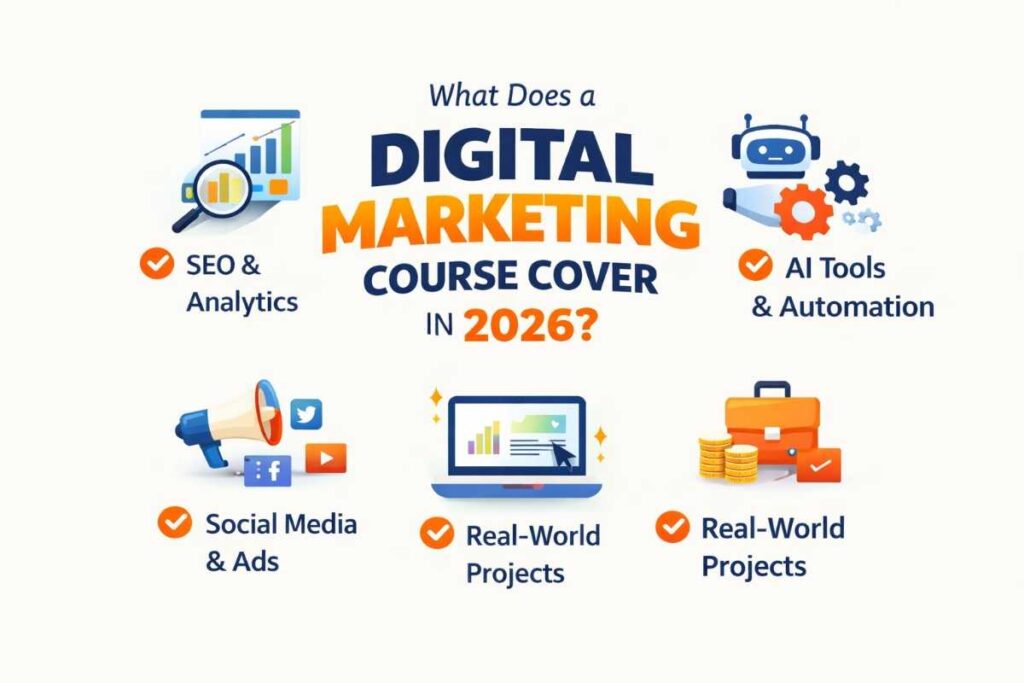
A common question among beginners and professionals alike is: What does a Digital Marketing Course Cover in 2026? The answer goes far beyond basic concepts. Modern courses are designed to equip learners with real-world skills, combining strategy, execution, and data-driven decision-making.
In 2026, a high-quality digital marketing course must move beyond theory and focus on advanced tools, AI-driven workflows, and performance-based strategies. This guide provides a detailed breakdown of what a comprehensive curriculum should include and how each module contributes to measurable business outcomes.
Understanding the Scope of Digital Marketing
At its core, digital marketing is about leveraging online channels to drive visibility, engagement, and conversions. These channels include search engines, social media platforms, email, paid advertising networks, and e-commerce marketplaces.
A modern course should train you in:
- Customer acquisition strategies
- Data-driven decision making
- Multi-channel campaign execution
- Automation and AI integration
The emphasis has shifted from “learning tools” to “building systems that generate revenue.”
Search Engine Optimization (SEO): The Foundation of Organic Growth
SEO remains one of the most critical modules in any course because it drives long-term, cost-effective traffic.
A robust curriculum typically includes:
Keyword Research & Search Intent
Understanding how users search is fundamental. You’ll learn to identify high-intent keywords and map them to different stages of the funnel.
On-Page Optimization
This involves optimizing:
- Titles and meta descriptions
- Heading structures
- Internal linking
- Content depth and readability
Technical SEO
You will work on:
- Website speed optimization
- Mobile responsiveness
- Indexing and crawlability
- Structured data
Link Building Strategies
Modern link building focuses on authority and relevance rather than volume. Techniques include outreach, guest posting, and digital PR.
Local SEO
Especially relevant for businesses in cities like Dehradun, this includes:
- Google Business Profile optimization
- Local citations
- Reviews management
E-E-A-T Principles
Google’s emphasis on Experience, Expertise, Authoritativeness, and Trustworthiness is now central to ranking.
Paid Advertising: Performance Marketing with Measurable ROI
Paid campaigns provide immediate visibility and are essential for scaling.
Google Ads Ecosystem
A course should cover:
- Search campaigns (intent-based targeting)
- Display campaigns (brand awareness)
- Shopping ads (e-commerce)
- YouTube ads (video marketing)
- Performance Max campaigns (AI-driven automation)
You’ll learn how to use platforms like Google Ads to:
- Structure campaigns
- Optimize bids
- Improve Quality Score
- Reduce cost per acquisition (CPA)
Social Media Advertising and Organic Strategy
Social media is no longer just about posting content—it’s a performance channel.
Paid Social (Meta Ads)
Training includes:
- Campaign setup in Ads Manager
- Audience targeting (custom, lookalike)
- Retargeting strategies
- Creative testing
Platforms such as Facebook Ads Manager are essential tools here.
Organic Social Growth
You will also learn:
- Content planning frameworks
- Short-form video strategy (Reels, Shorts)
- LinkedIn personal branding
- Community engagement
Content Marketing and Conversion-Focused Copywriting
Content drives both SEO and paid campaigns. A modern course emphasizes not just writing, but writing that converts.
Key Areas Covered
- Blog writing with SEO structure
- Landing page optimization
- Sales copywriting techniques
- Email sequences and funnels
You’ll also learn how to align content with user intent and buyer psychology.
Email Marketing: High-ROI Retention Channel
Despite being one of the oldest digital channels, email marketing remains highly effective.
Core Training Areas
- List building strategies
- Segmentation and personalization
- Automation workflows
- A/B testing
Tools like Mailchimp or similar platforms are often used for hands-on practice.
Analytics and Data Interpretation
Marketing without data is essentially guesswork. A well-structured digital marketing course trains you to measure, interpret, and optimize performance using reliable data sources, ensuring every decision is backed by insights rather than assumptions.
Google Analytics 4 (GA4)
Using Google Analytics 4, you learn how to track and analyze user interactions across websites and apps. This includes event tracking, where specific actions like clicks, form submissions, or purchases are monitored. You also study user behavior analysis to understand how visitors navigate your site, where they drop off, and what drives engagement.
Additionally, conversion tracking helps measure key business outcomes such as leads or sales, while funnel visualization allows you to identify bottlenecks in the customer journey and optimize them for better results.
Dashboard Creation and Reporting
With tools like Looker Studio, you learn to transform raw data into meaningful insights. This includes building custom reports, visualizing key performance indicators (KPIs), and creating dashboards that clearly communicate performance to clients or stakeholders. This skill is critical for decision-making and strategy refinement.
E-Commerce and Marketplace Marketing
With the growth of online shopping, e-commerce marketing is now a core skill.
Marketplace Strategies
Courses typically include:
- Product listing optimization
- Keyword ranking on marketplaces
- Sponsored ads
Platforms like Amazon and Flipkart are covered in detail.
Shopify Store Optimization
You’ll learn:
- Store setup and UX optimization
- Conversion rate optimization (CRO)
- Funnel building
Using Shopify, students often create real or demo stores.
AI Tools and Automation in Marketing
This is the defining element of a 2026-ready course.
AI Content and Strategy Tools
You will be trained on tools such as:
- ChatGPT
- Gemini
- Jasper
Applications of AI
- Content generation and ideation
- Ad copy creation
- Customer support automation
- Predictive analytics
Marketing Automation Platforms
Courses also introduce automation tools that:
- Manage leads
- Trigger email workflows
- Score prospects
The focus is on increasing efficiency while maintaining personalization.
Generative Search Optimization (GSO): The New SEO Layer
Generative Search Optimization (GSO) represents the next evolution of SEO, driven by AI-powered search engines that generate direct answers instead of simply listing web pages. With tools like Google Gemini influencing how users discover information, traditional keyword-focused SEO alone is no longer sufficient.
In this module, you learn how to optimize content specifically for AI-generated responses. This includes structuring content in a clear, question-answer format so it can be easily extracted by AI systems. You also focus on conversational queries, aligning content with how users naturally speak or ask questions, especially in voice search.
Another critical aspect is building strong topical authority—creating in-depth, well-connected content that signals expertise and trustworthiness. This improves the chances of your content being referenced in AI summaries.
Overall, GSO ensures your content remains visible in modern search environments, including AI overviews, featured snippets, and voice-assisted results, making it a crucial skill in 2026.
Practical Exposure: The Differentiating Factor
Theory alone does not create employability. The best institutes integrate practical learning at every stage.
Live Projects
Students work on:
- Real websites
- Campaign simulations
- SEO audits
Tool-Based Assignments
Hands-on tasks include:
- Running ad campaigns
- Building dashboards
- Creating content strategies
Internship Opportunities
Many institutes offer internships that provide:
- Client exposure
- Real budgets
- Performance tracking experience
This ensures you are job-ready from day one.
Skills You Actually Develop
- Plan and execute integrated multi-channel marketing campaigns (SEO, ads, social, email)
- Analyze user data and optimize performance using tools like Google Analytics 4
- Create high-converting content, including blogs, landing pages, and ad copy
- Run and optimize paid advertising campaigns with a strong ROI focus
- Perform audience targeting, segmentation, and retargeting strategies
- Build and manage sales funnels for lead generation and conversions
- Use AI tools like ChatGPT for content, research, and automation
- Develop data-driven decision-making and problem-solving skills
- Track KPIs and generate performance reports for campaigns
- Apply conversion rate optimization (CRO) techniques to improve results
These skills are practical, execution-oriented, and directly tied to generating measurable business outcomes.
Career Opportunities After Completion
A well-structured course opens multiple career paths:
Job Roles
- SEO Executive
- Performance Marketer
- Social Media Manager
- Content Strategist
- Email Marketing Specialist
Freelancing
You can offer services such as:
- Website SEO
- Ads management
- Content writing
Entrepreneurship
Many learners use these skills to:
- Launch dropshipping stores
- Build personal brands
- Start digital marketing agency
How to Evaluate a Good Digital Marketing Course
Selecting the right digital marketing course is a strategic decision that directly impacts your career trajectory. Many programs appear similar on the surface, but their depth, execution, and relevance vary significantly. Use the following evaluation criteria to make an informed choice:
1. Curriculum Depth and Industry Relevance
A strong curriculum should go beyond introductory concepts and reflect how digital marketing actually works in 2026.
What to verify:
- AI Integration: The course must include practical usage of tools like ChatGPT and Gemini for content, research, and automation.
- Analytics Proficiency: Training should cover Google Analytics 4, event tracking, and conversion analysis.
- Advanced Advertising: Look for modules on campaign structuring, audience segmentation, A/B testing, and scaling strategies—not just basic ad setup.
Why it matters:
A shallow syllabus produces theoretical knowledge, while a deep curriculum builds execution capability. Employers and clients prioritize professionals who can deliver results, not just understand concepts.
2. Practical Exposure and Real-World Application
Digital marketing is a performance-based field. Without hands-on experience, learning remains incomplete.
What to look for:
- Live Projects: Opportunities to work on real websites, SEO audits, or active ad campaigns.
- Case Studies: Detailed breakdowns of successful and failed campaigns to understand decision-making processes.
- Internship Opportunities: Exposure to client work, deadlines, and reporting structures.
Why it matters:
Practical exposure develops problem-solving skills, which are essential when dealing with real budgets, fluctuating performance metrics, and client expectations.
3. Tool-Based Training (Hands-On Learning)
Digital marketing relies heavily on tools. A quality course should ensure you are comfortable using them, not just aware of them.
Core tools to expect:
- Advertising Platforms: Google Ads and Facebook Ads Manager
- SEO Tools: Keyword research, site audits, and backlink analysis tools
- Email Marketing Software: Platforms like Mailchimp
- Reporting Tools: Looker Studio for dashboards
Why it matters:
Employers expect operational proficiency from day one. Knowing how to navigate and execute within these tools significantly increases your employability.
4. Updated and Future-Ready Content
Digital marketing evolves rapidly due to algorithm updates, platform changes, and emerging technologies.
What to check:
- Inclusion of Generative Search Optimization (GSO) and AI-driven search trends
- Coverage of short-form video strategies (Reels, Shorts)
- Regular updates to modules based on current industry practices
Warning signs of outdated courses:
- Focus only on legacy SEO techniques
- No mention of AI or automation
- Old interface screenshots or deprecated tools
Why it matters:
Outdated knowledge can make your skills irrelevant. A course must prepare you for current and near-future industry demands.
5. Mentorship and Support System
Beyond content, guidance plays a critical role in skill development.
Evaluate:
- Access to experienced mentors or industry professionals
- Doubt-solving sessions
- Feedback on assignments and projects
Why it matters:
Mentorship accelerates learning by helping you avoid common mistakes and refine your strategies based on real-world insights.
6. Performance Tracking and Skill Assessment
A professional course should measure your progress objectively.
Look for:
- Assignments with measurable KPIs
- Campaign performance analysis tasks
- Certification based on practical evaluation, not just attendance
Why it matters:
Assessment ensures that you are not just consuming content but actually developing competency.
7. Career Support and Placement Assistance
While not mandatory, career support can significantly enhance outcomes.
Check if the course offers:
- Resume and portfolio building
- Interview preparation
- Freelancing guidance or client acquisition strategies
Why it matters:
The ultimate goal is employability or income generation. Structured support reduces the gap between learning and earning.
Summary
A digital marketing course in 2026 extends beyond basic platform knowledge; it focuses on developing a performance-oriented mindset driven by data, automation, and artificial intelligence. The most effective programs are structured to combine strong foundational skills—such as SEO, paid advertising, and content marketing—with advanced capabilities in analytics, marketing automation, and AI-powered tools.
Equally important is practical exposure. High-quality courses incorporate live projects, real campaign execution, and internship opportunities to ensure learners gain hands-on experience alongside theoretical understanding. This approach bridges the gap between learning and real-world application.
When designed correctly, a digital marketing course does not merely teach concepts—it equips individuals with the ability to generate measurable business outcomes, optimize campaigns, and drive consistent growth.
For anyone aiming to build a serious career or scalable business in the digital domain, enrolling in a comprehensive, industry-relevant program is no longer optional; it is a fundamental requirement.
About the Author
Rohan Joshi is a director and digital marketing trainer at Hashtag Academy who believes in building skills through real-world application. With 8+ years of experience working across education, healthcare, and service industries, he helps students and businesses understand how digital strategies actually perform in live markets. His mission is to create confident professionals who can deliver measurable growth.