
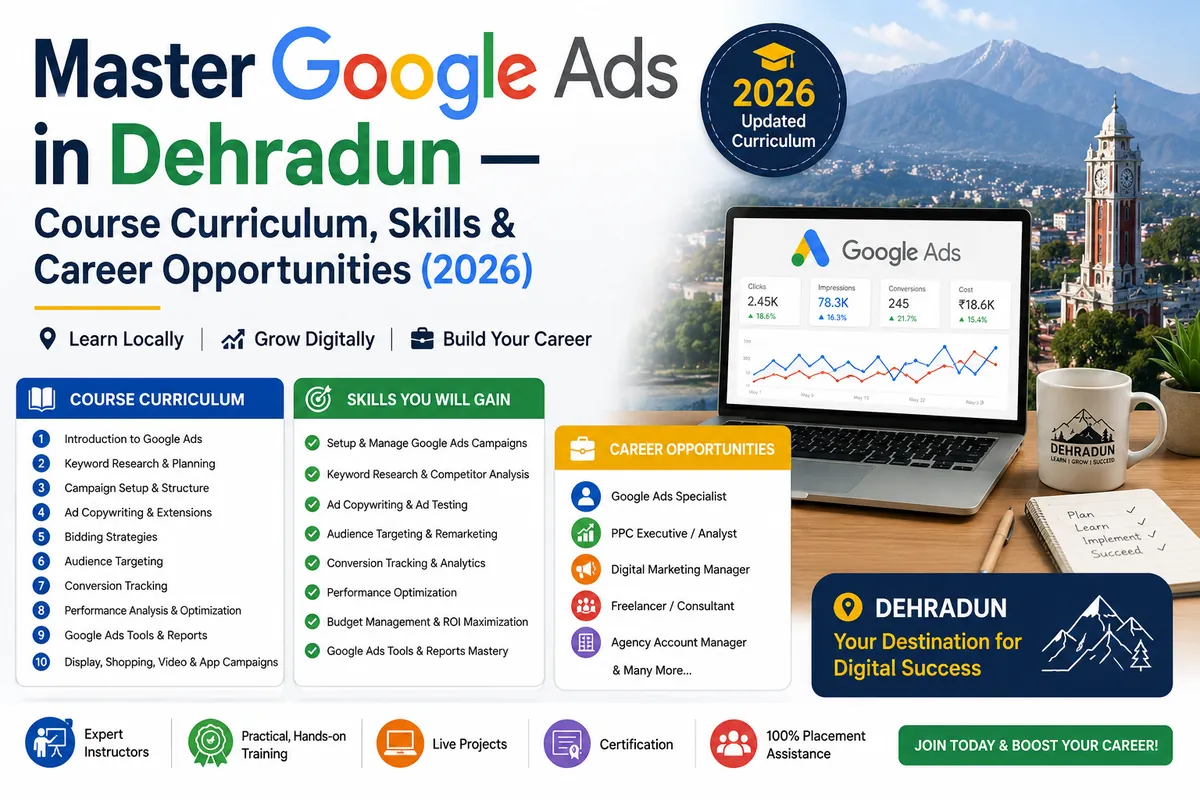
The digital marketing landscape in India has evolved at a breathtaking pace, and paid advertising sits right at the heart of it. If you are looking to build a sharp, job-ready skill set in performance marketing, enrolling in a Google Ads course in Dehradun is one of the smartest moves you can make in 2026. The city has quietly grown into a serious hub for digital education, drawing students from Uttarakhand and beyond who want structured, mentor-led training rather than scattered YouTube tutorials.
What makes Google Ads stand apart from every other digital marketing skill is its directness — every rupee you spend can be tracked, optimised, and attributed to a real business outcome. Brands across e-commerce, real estate, healthcare, education, and local services are allocating larger and larger chunks of their marketing budgets to paid search and paid social. That has created an urgent, sustained demand for professionals who understand how to build and manage campaigns that actually deliver returns, not just clicks.
Dehradun, with its growing cluster of digital agencies, EdTech startups, and freelance professionals, now offers learners a local ecosystem where theory and practice go hand in hand. This guide walks you through every module of a comprehensive Google Ads curriculum, the career paths that open up after you specialise, the Google Skillshop certification roadmap, and what you can realistically expect to earn in this field — whether you join an agency, go in-house, or build your own client base.
Why Google Ads Skills Are Non-Negotiable in 2026
Google continues to command roughly 90% of the global search engine market. In India, businesses collectively spend thousands of crores every year running Search, Display, Shopping, and YouTube campaigns. Yet the talent gap between the number of campaigns being launched and the number of people who truly understand how to run them profitably remains wide.
A specialist who can read a Search Impression Share report, diagnose a Quality Score problem, restructure a Shopping feed, and set up GA4 conversion tracking is genuinely rare. That rarity translates directly into salary leverage, freelance pricing power, and career stability. Employers are not just looking for someone who can set a daily budget — they want strategists who can scale ad spend responsibly while maintaining or improving ROAS.
The Full Google Ads Course Curriculum — Module by Module
Module 1: Google Ads Fundamentals and Account Architecture
Before touching a live campaign, you need to understand the platform’s logic. This module covers the hierarchy of accounts, campaigns, ad groups, ads, and keywords. You will learn about match types — broad, phrase, and exact — and why choosing the wrong one burns budget silently. Negative keyword lists, campaign goals, and bidding strategies (manual CPC, enhanced CPC, Target CPA, Target ROAS, Maximise Conversions) are explored in detail, along with Quality Score mechanics and how ad rank is calculated in each auction.
Module 2: Search Campaign Mastery
Search campaigns are the backbone of Google Ads. This module teaches you to build tightly themed ad groups, write compelling Responsive Search Ads that score “Excellent” on ad strength, and use all available ad extensions — sitelinks, callouts, structured snippets, call extensions, and image extensions. You will work on keyword research using Google Keyword Planner, SEMrush, and Ahrefs, and learn how to interpret search term reports to find high-intent queries you hadn’t thought to bid on.
Campaign structure strategies — SKAG (Single Keyword Ad Groups) vs thematic grouping — are debated and tested. Students run live campaigns on small budgets and analyse the results against defined KPIs.
Module 3: Google Display Network and Remarketing
The Display Network reaches over 90% of internet users worldwide through millions of partner websites and apps. This module covers audience targeting options — affinity audiences, in-market audiences, custom intent audiences, and customer match. You will learn how to design responsive display ads, set frequency caps to avoid ad fatigue, and build remarketing lists based on website visitors, app users, and YouTube viewers.
A major focus is on remarketing strategy: identifying the right window for re-engagement, creating audience segments based on on-site behaviour, and writing ad copy that speaks to a warm audience differently from a cold one.
Module 4: Google Shopping Campaigns and Product Feed Optimisation
Shopping ads are the dominant format for e-commerce businesses, and managing them well requires skills that go beyond the Ads interface. This module introduces Google Merchant Center — how to set up a product feed, troubleshoot disapproved products, and optimise titles, descriptions, and custom labels for better auction eligibility.
Students learn to structure Shopping campaigns using campaign priority settings, build product groups with logical subdivisions (category, brand, product type, custom label), and use negative keywords effectively within Shopping — something many practitioners overlook entirely.
Module 5: YouTube Advertising
Video advertising on YouTube has matured into a sophisticated performance channel, not just a brand awareness tool. This module covers all major YouTube ad formats: skippable in-stream ads, non-skippable ads, bumper ads, in-feed video ads, and the newer Shorts ads. You will learn how to set up a Video campaign, use video action campaigns for direct response, and target audiences using keywords, topics, placements, and demographic overlays.
Creative strategy is a core part of this module — understanding the ABCD framework (Attention, Branding, Connection, Direction) and how the first five seconds of a video ad determine whether a viewer skips or stays.
Module 6: Performance Max Campaigns
Performance Max (PMax) is Google’s fully automated, omnichannel campaign type that serves ads across Search, Display, YouTube, Gmail, and Maps from a single campaign. Understanding PMax is now essential for any serious practitioner.
This module explains how asset groups work, how to write high-quality headlines, descriptions, and CTAs that feed the machine learning model, and critically, how to use audience signals to guide Google’s targeting without over-constraining it. Students also learn how to interpret PMax insights reports, identify which channels are driving conversions, and use supplemental feed data to extend reach.
Module 7: Conversion Tracking, GA4 Integration, and Attribution
This is arguably the most important module in the entire curriculum and the one most often skipped by self-taught practitioners. Without accurate conversion tracking, every optimisation decision is built on guesswork.
Students learn to set up Google Tag Manager, configure GA4 events and conversions, link GA4 to Google Ads, and import conversion actions. The module covers enhanced conversions — which improve measurement accuracy in a privacy-first world — and Google Ads conversion tracking vs GA4 imported conversions, including when to use each.
Attribution modelling is explored in depth: last-click, first-click, linear, position-based, time decay, and data-driven attribution. You will learn how changing your attribution model changes which keywords and campaigns get credit, and therefore which ones you scale or pause. Understanding attribution is directly connected to making smart budget allocation decisions.
Module 8: ROAS Optimisation and Advanced Bidding Strategy
The final module is where strategy comes together. You will learn how to calculate a target ROAS for different product categories, set up automated bidding strategies, and interpret the recommendations Google makes — learning which ones to accept and which ones to scrutinise.
Topics include: portfolio bidding strategies, seasonality adjustments, bid modifiers for devices, locations, and audiences, and how to run proper A/B experiments using Google Ads Experiments (Drafts & Experiments). Students analyse real account data to identify the highest-leverage optimisation opportunities — whether that’s a wasted spend issue, a landing page problem, or a creative refresh need.
A critical skill taught in this module is understanding how to reduce cost per click in Google Ads through Quality Score improvements, relevance engineering, and smart bidding calibration rather than simply lowering bids. See our detailed guide on How to Reduce Cost Per Click in Google Ads for a deep-dive into these techniques.
Google Skillshop Certification Path
Google’s free Skillshop platform offers certifications across every major product. After completing a structured course, you should pursue the following in order:
1. Google Ads Search Certification — the foundational credential every employer expects.
2. Google Ads Display Certification — demonstrates competency across the Display Network and audience targeting.
3. Google Ads Shopping Certification — essential if you plan to work with e-commerce clients.
4. Google Ads Video Certification — covers YouTube campaign management and video creative strategy.
5. Google Ads Measurement Certification — arguably the most undervalued credential; proves you understand attribution, tracking, and GA4.
6. Google Analytics Certification (GA4) — now a standard complement to the Ads certifications since GA4 is the measurement backbone for all campaign decisions.
Each certification exam takes roughly 75 minutes and requires a passing score of 80%. Certifications are valid for one year, which keeps you motivated to stay current as the platform evolves.
Career Roles After Specialising in Google Ads
PPC Manager
A PPC Manager owns the paid search strategy for an organisation or a portfolio of client accounts at an agency. Day-to-day responsibilities include campaign builds, budget management, bid strategy adjustments, weekly performance reporting, and liaison with creative teams for ad copy and landing page testing. In agencies, PPC Managers typically handle accounts across multiple industries simultaneously.
Expected salary range in India (2026): ₹4.5 LPA – ₹9 LPA for 1–3 years of experience; ₹9 LPA – ₹18 LPA for senior roles.
Performance Marketing Specialist
This role is broader than PPC alone — a Performance Marketing Specialist manages paid acquisition across Google Ads, Meta Ads, and increasingly programmatic channels. They are expected to understand the full funnel, from top-of-funnel awareness campaigns to bottom-of-funnel ROAS optimisation, and to tie all activity back to revenue and growth targets.
Expected salary range in India (2026): ₹5 LPA – ₹10 LPA at mid-level; ₹12 LPA – ₹22 LPA+ for senior performance leads at growth-stage startups or large e-commerce companies.
Freelance Google Ads Consultant
Many Google Ads specialists in Dehradun choose the freelance route, managing campaigns for local businesses, national brands, and international clients. A freelancer with strong results and a clean portfolio can charge ₹15,000 – ₹60,000 per month per client, depending on ad spend managed and scope of work. Building even a small client base of 4–6 accounts creates a highly flexible and lucrative income stream.
In-House Performance Marketer
Startups, D2C brands, and established businesses increasingly prefer in-house performance marketers who understand their product deeply. This path offers stability, a single brand focus, and often significant learning opportunities as you scale campaigns from scratch alongside a growing business.
Why Dehradun Is an Increasingly Compelling Place to Build a Digital Career
Beyond the quality of life — the climate, the cost of living, the proximity to the mountains — Dehradun’s digital ecosystem is genuinely maturing. A growing number of agencies, EdTech companies, and remote-first startups are establishing a presence here, creating real employment opportunities for skilled digital marketers without requiring relocation to Delhi or Bengaluru.
For those exploring broader career paths in the region, it is worth reading about the Best Career Options in Dehradun to understand how digital marketing fits alongside other growing industries like tourism tech, ed-tech, and remote corporate roles. Google Ads specialists are among the most sought-after digital professionals in this market precisely because the skill is measurable, results-driven, and directly tied to revenue.
What to Look for in a Google Ads Course in Dehradun
Not every course is equal. When evaluating your options, ask these questions:
Is the curriculum updated for 2026? Google Ads evolves constantly — Performance Max, GA4, enhanced conversions, and Demand Gen campaigns are all relatively recent additions that older curricula may not cover.
Do you get hands-on campaign access? Theory without practice does not prepare you for a job. Look for courses that give you live campaign experience, even on small budgets, with real accounts.
Is GA4 and conversion tracking included? Many courses teach the front end of campaign management while completely neglecting measurement. This is a major gap.
Is there placement support or industry networking? In a city like Dehradun, connections to local agencies and in-house teams matter enormously for your first role.
Are instructors currently practising? Look for educators who are managing real ad budgets today, not those who last ran a campaign several years ago.
Conclusion
Google Ads is no longer an optional skill for digital marketers — it is a core competency that separates professionals who can demonstrate business impact from those who cannot. The curriculum outlined in this guide — spanning Search, Display, Shopping, YouTube, Performance Max, GA4 attribution, and ROAS optimisation — represents a complete, current, and career-ready education in paid advertising. For learners in Uttarakhand, completing a structured Google Ads course in Dehradun means gaining this expertise without uprooting your life, within a growing local ecosystem that increasingly rewards these skills.
The combination of Google Skillshop certifications, hands-on campaign experience, and a clear understanding of attribution and measurement positions you for roles that pay well, grow quickly, and remain in demand regardless of economic cycles. Whether your goal is an agency career, an in-house role, or an independent freelance practice, the investment in mastering Google Ads is one that compounds — every campaign you run makes you sharper, every account you optimise strengthens your portfolio, and every ROAS you
About the Author
Rohan Joshiis a director and digital marketing trainer at Hashtag Academy who believes in building skills through real-world application. With 8+ years of experience working across education, healthcare, and service industries, he helps students and businesses understand how digital strategies actually perform in live markets. His mission is to create confident professionals who can deliver measurable growth.