
A few months ago, a business owner in Dehradun told me she’d stopped worrying about her Google ranking. What she actually wanted to know was why her competitor kept showing up inside ChatGPT’s answers when customers asked “best digital marketing agency near me.” She wasn’t losing to a better website. She was losing to a website that AI trusted more.
That conversation sums up where marketing stands right now. Search hasn’t disappeared — it has split in two. There’s still the classic blue-links world, and now there’s a parallel universe of AI Overviews, ChatGPT responses, Perplexity summaries, and Gemini answers, all deciding which brands get mentioned and which get ignored. Learning to win in both worlds is quickly becoming one of the most valuable — and most profitable — skills a marketer can have. This guide walks through exactly how to build and monetize solid AEO and GEO marketing strategies, step by step, without the jargon overload.
What Are AEO and GEO, Really?
Let’s clear up the alphabet soup first, because most explanations online make this more complicated than it needs to be.
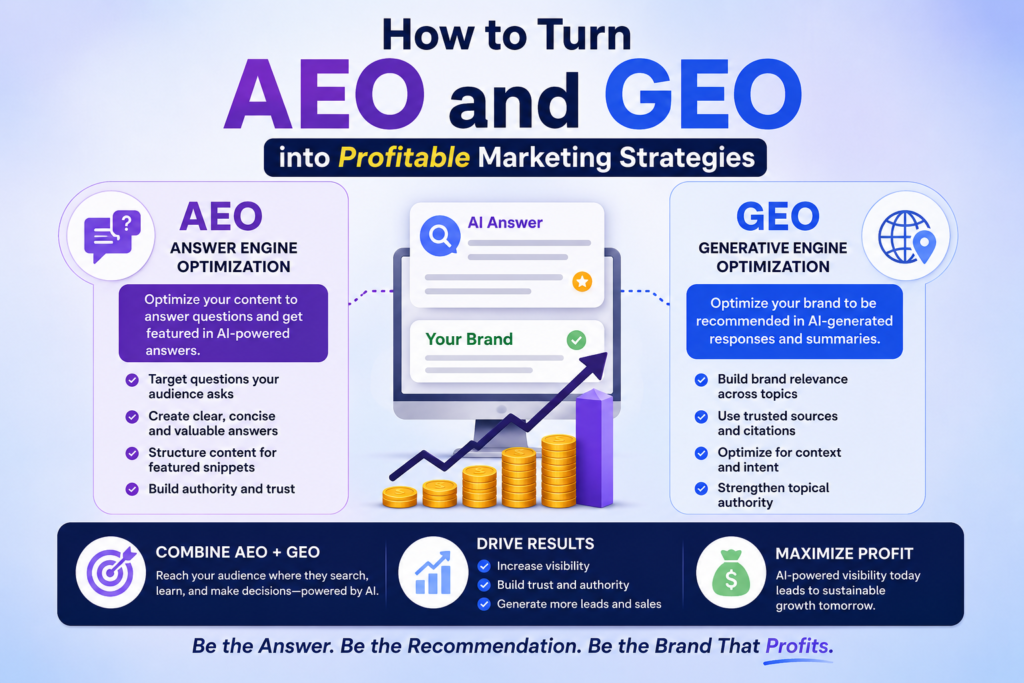
Answer Engine Optimization (AEO) is the practice of structuring your content so that AI-powered answer engines — think Google’s featured snippets, voice assistants, and AI Overviews — can pull a clear, direct answer from your page and present it to the user. It’s less about ranking #1 on a results page and more about becoming the source an engine quotes or paraphrases.
Generative Engine Optimization (GEO) goes a step further. It’s about optimizing your content so that generative AI tools like ChatGPT, Gemini, and Perplexity choose to cite or reference your brand when they generate a conversational answer from scratch, often without showing any traditional search results at all. GEO cares less about keyword density and more about how credible, well-structured, and “quotable” your content appears to a language model synthesizing an answer.
Both AEO and GEO are built on the same foundation as traditional SEO — they’re not a replacement for it, they’re an evolution of it. If you’ve never worked through the basics of how search engines evaluate a website, it’s worth revisiting What SEO actually is before layering AEO and GEO on top. Traditional SEO earns you visibility in the search results. AEO and GEO earn you visibility inside the answer itself — which, increasingly, is the only thing a lot of users ever see.
Here’s a simple way to think about the difference:
| Aspect | Traditional SEO | AEO | GEO |
| Goal | Rank high in search results | Get featured as a direct answer | Get cited inside AI-generated responses |
| Primary platform | Google, Bing search results | Featured snippets, voice search, AI Overviews | ChatGPT, Gemini, Perplexity, Copilot |
| Content style | Keyword-optimized pages | Concise, structured, question-based answers | Authoritative, well-sourced, easy-to-summarize content |
| Success metric | Rankings, organic traffic | Snippet ownership, position zero | Citation frequency, brand mentions in AI answers |
Why This Shift Is Happening Right Now
For almost two decades, the mental model of search was simple: type a query, get ten blue links, click the one that looks best. That model is breaking down fast, and it’s not a minor UX tweak — it’s a fundamental change in how people find information.
Google’s AI Overviews now sit at the very top of a huge share of search results, answering the query before the user scrolls to a single organic listing. Millions of people have shifted part of their search behavior to ChatGPT, treating it like a research assistant instead of a search engine. Perplexity has built its entire product around citing sources in real time. Gemini is baked directly into Android phones and Google Workspace, quietly becoming the default research tool for an entire generation of users.
The practical effect is that a growing number of searches never result in a click at all. The user gets their answer, is satisfied, and moves on — and if your brand wasn’t part of that answer, you were invisible for that entire interaction. This is why marketers, business owners, and agencies are scrambling to understand AI search optimization: the risk of doing nothing is no longer “lower rankings,” it’s “total absence from the conversation.”
This is also precisely why smart marketers are treating AEO and GEO as the next big service line rather than a passing trend. The businesses that show up inside AI answers today are building a compounding advantage — every citation reinforces the model’s trust in them, making future citations more likely. Getting in early isn’t optional anymore; it’s a competitive necessity.
How AI and Answer Engines Decide What to Cite
This is the part most articles skip past too quickly, and it’s the part that actually matters if you want results. AI search optimization isn’t about guessing — the engines are surprisingly consistent about what they reward.
Structured, machine-readable content. Answer engines favor content that’s already organized into clear headings, numbered steps, definitions, and question-and-answer formats. Schema markup (FAQ schema, HowTo schema, Article schema) gives these systems an even more direct signal about what your content contains, making it easier for a crawler or model to extract and reuse.
E-E-A-T signals. Experience, Expertise, Authoritativeness, and Trustworthiness aren’t just a Google concept anymore — generative models are trained to weigh source credibility too. Author bios, cited data, transparent sourcing, and a consistent publishing history all feed into whether an AI model treats your content as reliable enough to reference.
Concise, extractable answers. AI systems tend to reward the first few sentences under a heading that directly and completely answer the implied question, before expanding into more detail. If your key point is buried in paragraph four, you’re making the engine work harder to find it — and it may simply choose a competitor’s page instead.
Third-party mentions and brand consistency. This is the one most marketers underestimate. Generative engines don’t just look at your website — they build a picture of your brand from review sites, forums, news mentions, comparison articles, and social proof scattered across the internet. The more consistently your brand is described (same positioning, same claims, same expertise area) across multiple credible sources, the more confidently an AI model will surface you as an answer.
This overlap between structured content and off-site authority is exactly why on-page and off-page work still matter so much in an AI-first world — they’re two halves of the same trust signal, which is a good reason to get comfortable with how on-page and off-page SEO work together before building out an AEO/GEO content plan.
A Step-by-Step Strategy to Optimize for AEO and GEO
Here’s where theory turns into a repeatable process. None of this requires starting from zero — it builds directly on solid SEO habits.
- Map the real questions your audience is asking. Go beyond keyword tools. Look at “People Also Ask” boxes, Reddit threads, Quora questions, and even the exact phrasing customers use in support chats. AI engines are answering conversational questions, so your content needs to mirror that natural, spoken phrasing rather than stiff keyword strings.
- Structure every page around one clear answer per section. Open each section with a two-to-three sentence direct answer, then expand with supporting detail, examples, or data. This “answer-first” structure is the single biggest lever for both AEO and GEO visibility.
- Add schema markup wherever it applies. FAQ schema, HowTo schema, and Article schema aren’t optional extras anymore — they’re the clearest signal you can send to a crawler about what your page contains and how it’s organized.
- Build topical depth, not just isolated posts. A single well-optimized article helps, but a cluster of interlinked pages covering a topic from multiple angles builds the kind of authority that generative engines associate with genuine expertise. Interlinking your own content (the way this article links back to foundational SEO concepts) also strengthens that topical signal.
- Earn third-party citations deliberately. Pitch guest posts, get listed in industry roundups, respond to journalist queries, and encourage genuine reviews. Every credible external mention increases the odds an AI model treats your brand as a trustworthy answer source.
- Keep content fresh and dated. Generative engines tend to favor recently updated information, especially for anything involving pricing, statistics, or “best of” style comparisons. Revisit and update cornerstone content on a regular cycle instead of publishing once and forgetting it.
- Optimize for voice and conversational queries too. Since many AI interactions happen through spoken or chat-style input, writing in a natural, conversational tone — the way this article is written — genuinely improves your odds of extraction compared to dense, jargon-heavy copy.
Turning This Into a Profitable Service: Monetizing AEO and GEO
This is the section that turns knowledge into income, and it’s worth spending real time on because the opportunity here is unusually early-stage.
Package it as a new service line. Most small and mid-sized businesses have never heard the terms AEO or GEO, let alone audited their AI visibility. That knowledge gap is your opening. Freelancers and agencies can offer a standalone “AI Search Visibility Audit” — checking whether a brand appears in ChatGPT and Gemini answers for its core queries — as a lead-generation product that naturally upsells into ongoing optimization work.
Use it as a retainer upsell. If you already manage SEO for clients, AEO and GEO work slots in naturally as a premium add-on. Clients who are already paying for content and technical SEO are often willing to pay more once they understand that AI Overviews and ChatGPT are quietly eating into their organic traffic — you’re not selling something new, you’re closing a gap they didn’t know existed.
Build personal brand authority around it. Because generative AI marketing is still relatively unclaimed territory, marketers who publish consistently about AEO and GEO — case studies, experiments, before-and-after citation data — position themselves as go-to experts far faster than they could in the saturated traditional SEO space. This authority compounds: speaking opportunities, higher-ticket clients, and course or coaching income tend to follow naturally once you’re seen as ahead of the curve.
Offer productized deliverables. Rather than vague “AI optimization” retainers, package specific outputs: FAQ schema implementation, answer-first content rewrites, AI citation tracking reports, and quarterly visibility audits. Clients pay more easily for clearly defined deliverables than for abstract strategy work.
The marketers moving fastest right now are the ones treating AEO and GEO not as a technical curiosity but as an actual AEO and GEO marketing strategy they can sell — and that mindset shift, more than any single tactic, is what separates people earning real income from this trend and people still reading about it. If you want to build this skillset properly instead of piecing it together from scattered articles, a structured, practical advanced Digital Marketing Course in Dehradun is a solid way to turn this into a real, monetizable service rather than a half-finished side project.
Tools to Track Your AI Search Visibility
You can’t improve what you don’t measure, and AI visibility tracking is a genuinely new category of tooling. A few approaches worth building into your workflow:
- Manual prompt testing: Regularly ask ChatGPT, Gemini, and Perplexity the exact questions your target audience would ask, and log whether your brand appears, how it’s described, and which competitors show up instead.
- AI citation tracking platforms: A growing set of tools now specialize in monitoring brand mentions across generative engines, similar to how rank trackers monitor Google positions — worth exploring as this category matures.
- Google Search Console: Still valuable for spotting AI Overview impressions and understanding which queries are triggering AI-generated answers instead of traditional listings.
- Schema validation tools: Regularly checking that your structured data is error-free ensures answer engines can actually parse what you’ve built for them.
- Brand mention alerts: Simple mention-tracking tools help you catch third-party citations across news sites, forums, and review platforms — the off-site signals that feed generative engine trust.
Common Mistakes Marketers Make With AEO and GEO
A few patterns show up again and again, and avoiding them saves months of wasted effort. Treating GEO as “SEO with extra steps” is one of the biggest — the intent behind an AI-generated answer is often different from a search results click, and copying old SEO content word-for-word rarely earns a citation. Ignoring E-E-A-T signals is another common trap; brands that skip author credentials, transparent sourcing, or genuine expertise markers struggle to earn AI trust no matter how well-structured their pages are. Overstuffing content with keywords instead of writing naturally also backfires, since generative models are specifically trained to favor conversational, human-sounding writing over mechanical optimization. Finally, many marketers stop at on-page changes and neglect off-site authority entirely — a mistake, since third-party mentions are one of the strongest trust signals generative engines rely on.
Frequently Asked Questions
What is the difference between AEO and GEO? AEO focuses on getting your content featured as a direct answer in search features like featured snippets and AI Overviews, while GEO focuses on getting cited or referenced inside AI-generated conversational responses from tools like ChatGPT and Gemini.
Is GEO replacing traditional SEO? No. GEO builds on the same foundations as SEO — quality content, technical health, and authority signals — but adds a layer optimized specifically for how generative AI models select and summarize information.
How long does it take to see results from AEO and GEO efforts? Timelines vary, but many marketers begin noticing early AI citation improvements within a few months of consistent structured content updates and off-site authority building, similar to how organic SEO results typically compound over time.
Can small businesses realistically compete in AI search results? Yes, often more easily than in traditional SEO. Because AI engines value clarity, credibility, and well-structured answers, a smaller brand with focused, well-organized content can out-perform a much larger competitor with cluttered or outdated pages.
Do I need coding skills to implement AEO and GEO? Basic schema markup implementation is helpful but not mandatory to start. Many of the highest-impact steps — answer-first writing, topical content clusters, and earning third-party mentions — are strategic and content-based rather than technical.
Conclusion
AI search isn’t a future trend to prepare for someday — it’s already reshaping how people find businesses, compare services, and make decisions, right now, in 2026. Marketers who understand how to build genuine AEO and GEO marketing strategies aren’t just protecting their visibility, they’re positioning themselves at the front of one of the most valuable emerging skillsets in digital marketing.
The good news is that none of this requires abandoning what you already know. It requires building on it — sharper content structure, stronger authority signals, and a genuine understanding of how these new engines think, choose, and cite. Start small: rewrite one page with an answer-first structure, add proper schema, chase one credible third-party mention, and track whether your brand starts showing up when you test your own prompts in ChatGPT or Gemini. That single feedback loop, repeated consistently, is what compounds into real AI search visibility over time.
The shift from ten blue links to AI-generated answers is one of the biggest changes search has seen in years. The marketers who adapt early won’t just survive it — they’ll be the ones the AI engines are quoting.
About the Author
Rohan Joshi is a director and digital marketing trainer at Hashtag Academy who believes in building skills through real-world application. With 8+ years of experience working across education, healthcare, and service industries, he helps students and businesses understand how digital strategies actually perform in live markets. His mission is to create confident professionals who can deliver measurable growth.