Most beginners jump into SEO without knowing where to start. They publish a blog post, share it on social media, maybe buy a few backlinks, and then wonder why their website still isn’t ranking on Google. The confusion usually comes down to one question: should you focus on what’s happening inside your website, or on what’s happening outside it?
This is exactly where the debate of On-Page SEO vs Off-Page SEO becomes important. Both play a role in how Google ranks your pages, but they work in completely different ways, and getting the sequence wrong can waste months of effort. In this guide, you’ll learn what each type of SEO actually means, how they differ, which ranking factors belong to each, real-world examples, a comparison table, common mistakes beginners make, a decision framework for prioritizing one over the other, and a practical 30-day plan you can start using today.
What Is SEO, in Simple Terms?
Before comparing the two, it helps to understand the bigger picture. SEO, or Search Engine Optimization, is the practice of improving a website so it ranks higher in search results and attracts organic traffic. If you’re new to the concept entirely, this guide on What is SEO? breaks down the fundamentals in plain language before diving into strategy.
SEO is generally split into two pillars: what you control directly on your website, and what happens beyond your website to build trust and authority. That split is the foundation of this entire discussion.
What Is On-Page SEO?
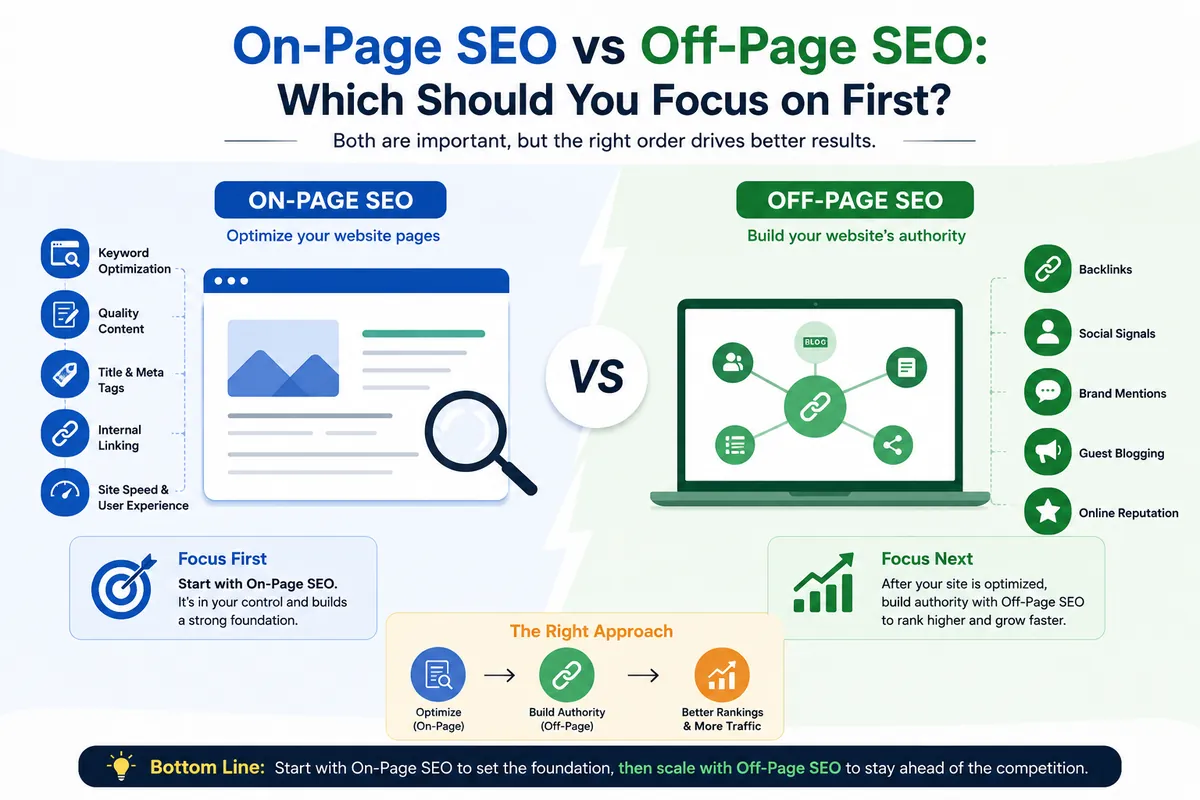
On-Page SEO refers to all the optimizations you make directly on your website to help search engines understand your content and rank it for relevant queries. This includes your content quality, keyword placement, title tags, meta descriptions, header structure, internal linking, image optimization, URL structure, and page loading speed.
Think of On-Page SEO as the foundation of a house. If the foundation is weak, no amount of external decoration will make the house stand strong. A page with thin content, missing headers, or slow load times will struggle to rank, no matter how many backlinks point to it.
For a complete breakdown of every on-page element, you can refer to this detailed resource on What is On-Page SEO? Complete Guide.
Key On-Page SEO factors include:
Title tags and meta descriptions that include the target keyword naturally and encourage clicks.
Header tags (H1, H2, H3) that organize content logically for both readers and search engines.
Keyword placement in the first 100 words, subheadings, and body content without overstuffing.
Internal linking that connects related pages and helps search engines crawl your site efficiently.
Image alt text and compressed file sizes for faster loading and accessibility.
Mobile responsiveness and Core Web Vitals, since Google now prioritizes mobile-first indexing.
What Is Off-Page SEO?
Off-Page SEO covers everything that happens outside your website to build its authority, trustworthiness, and reputation in the eyes of search engines. The most well-known element is backlinks, but Off-Page SEO also includes brand mentions, social signals, guest posting, influencer outreach, and online reviews.
If On-Page SEO is the foundation, Off-Page SEO is the reputation your house builds in the neighborhood. A well-built house that nobody trusts or recommends will still struggle to attract visitors. Google treats backlinks and mentions as votes of confidence from other websites, signaling that your content is credible and worth ranking.
To understand this in more depth, check out this guide on What is Off-page SEO?, which covers link-building strategies and authority-building techniques in detail.
Key Off-Page SEO factors include:
High-quality backlinks from authoritative and relevant websites.
Guest blogging on niche-related sites to build referral traffic and authority.
Social media engagement and shares that increase content visibility.
Online reviews and brand mentions across forums, directories, and news sites.
Influencer or industry collaborations that expose your content to new audiences.
Difference Between On-Page and Off-Page SEO
The core difference between On-Page and Off-Page SEO lies in control and location. On-Page SEO happens within your website, and you have full control over it. Off-Page SEO happens outside your website, and you have indirect influence over it through outreach, relationships, and content quality that naturally earns links.
Here’s a side-by-side comparison to make the distinction clearer:
| Factor | On-Page SEO | Off-Page SEO |
| Location | Within your website | Outside your website |
| Control | Full control | Indirect control |
| Main Focus | Content quality, structure, keywords | Backlinks, authority, reputation |
| Examples | Title tags, headers, internal links, page speed | Backlinks, guest posts, social shares, reviews |
| Time to See Results | Faster, often within weeks | Slower, builds over months |
| Risk Level | Low, mostly technical fixes | Higher, low-quality links can cause penalties |
| Primary Goal | Help Google understand your content | Help Google trust your content |
Why On-Page SEO Should Come First
Search engines evaluate both content quality and website authority, but they evaluate them in a specific order. Google first crawls and indexes your page to understand what it’s about. If your On-Page SEO is weak, search engines may struggle to interpret your content correctly, even if you have strong backlinks pointing to that page.
Imagine spending months earning fifty backlinks to a page that has thin content, no clear headers, and a confusing structure. Those backlinks will struggle to translate into rankings because the page itself doesn’t give Google enough signal about relevance. On the other hand, a well-optimized page with solid On-Page SEO can rank for long-tail keywords even with minimal backlinks, simply because it answers the search query clearly.
This is why most experienced SEO professionals recommend building a strong On-Page SEO foundation before investing heavily in Off-Page strategies. It’s not that Off-Page SEO doesn’t matter. It’s that On-Page SEO determines whether your Off-Page efforts actually pay off.
A Real-World Example
Consider two websites selling handmade candles. Website A spends three months building fifty backlinks to its homepage but ignores product descriptions, image alt text, and internal linking. Website B spends the same three months optimizing every product page with unique descriptions, proper headers, fast load times, and internal links, while earning just ten natural backlinks through outreach.
In most cases, Website B will outperform Website A in search rankings for specific product keywords, because Google can clearly understand and trust the relevance of each page. Website A’s backlinks may boost domain authority slightly, but without strong On-Page signals, those links struggle to convert into actual rankings for relevant searches.
Common Mistakes Beginners Make
Many beginners chase backlinks before fixing basic on-page issues like missing meta descriptions or duplicate title tags. This wastes both time and link-building budget.
Another common mistake is keyword stuffing, where writers repeat the primary keyword unnaturally throughout the content, hoping it improves rankings. Modern search algorithms penalize this practice rather than reward it.
On the Off-Page side, a frequent error is buying low-quality backlinks from spammy directories or link farms. These links can trigger Google penalties instead of boosting authority, undoing months of legitimate SEO work.
Ignoring mobile optimization is another overlooked mistake. Since Google uses mobile-first indexing, a page that performs poorly on mobile devices will rank lower regardless of how strong its backlink profile is.
Common SEO Myths, Debunked
Myth 1: More backlinks always mean better rankings. Quality matters far more than quantity. Ten backlinks from authoritative, relevant sites outperform a hundred links from low-quality directories.
Myth 2: On-Page SEO is a one-time task. Search algorithms evolve constantly, and content needs regular updates to stay relevant and competitive.
Myth 3: Off-Page SEO only means backlinks. Brand mentions, social signals, and online reviews also contribute to off-page authority, even without a direct link.
Myth 4: You should focus on Off-Page SEO immediately for faster rankings. Without a solid on-page foundation, Off-Page efforts often deliver diminishing returns.
Decision Framework: When to Prioritize Each
If your website is brand new, prioritize On-Page SEO first. Focus on content quality, site structure, and technical fixes for at least the first two to three months.
If your website already has strong, well-optimized content but low visibility, shift focus toward Off-Page SEO through guest posting, outreach, and building genuine backlinks.
If you’re targeting highly competitive keywords, you’ll likely need to invest in both simultaneously, since competitors in saturated niches usually have strong on-page content and large backlink profiles.
If your traffic has plateaued despite good content, audit your backlink profile first, since a lack of authority signals may be holding you back, even with excellent on-page work.
Free Tools to Implement Both Strategies
For On-Page SEO, Google Search Console helps track indexing issues and keyword performance, while Yoast SEO or Rank Math (for WordPress users) guide on-page optimization in real time. Google PageSpeed Insights helps identify speed and Core Web Vitals issues.
For Off-Page SEO, Google Alerts helps you track brand mentions across the web, while Ubersuggest and Ahrefs’ free backlink checker let you analyze your current backlink profile and find new link-building opportunities. AnswerThePublic can also help identify content gaps that naturally attract backlinks.
A Practical 30-Day SEO Action Plan
Week 1 should focus entirely on On-Page foundations: fix title tags, meta descriptions, header structure, and internal linking across your top ten pages.
Week 2 should address technical SEO: improve page speed, fix broken links, ensure mobile responsiveness, and submit an updated sitemap through Google Search Console.
Week 3 should shift toward content quality: update thin or outdated pages, add relevant images with alt text, and ensure each page targets a clear search intent.
Week 4 should begin Off-Page efforts: reach out to five relevant websites for guest posting opportunities, request reviews from existing customers, and share your best content across social platforms to start building natural backlinks.
By following this sequence, beginners build a technically sound, content-rich website before chasing external authority, which leads to more sustainable, long-term ranking improvements.
Benefits of Balancing Both SEO Types
Websites that balance On-Page and Off-Page SEO tend to rank higher and maintain their positions longer, since they satisfy both relevance and authority signals that Google evaluates. They also experience more stable traffic, since they’re less vulnerable to algorithm updates that specifically target either weak content or manipulative link-building practices.
A balanced approach also improves user experience, since strong on-page elements like clear navigation and fast loading combine with off-page trust signals like reviews and mentions to build genuine credibility with real visitors, not just search engines.
Frequently Asked Questions
1. What is the main difference between On-Page and Off-Page SEO? On-Page SEO involves optimizations within your website, like content and headers, while Off-Page SEO involves external factors, like backlinks and brand mentions, that build authority.
2. Should beginners focus on On-Page SEO first? Yes, building a strong on-page foundation first ensures that future off-page efforts, like backlinks, actually translate into better rankings.
3. Can a website rank well with only On-Page SEO? For low-competition, long-tail keywords, strong on-page content alone can rank well. For competitive keywords, Off-Page SEO becomes necessary too.
4. How long does Off-Page SEO take to show results? Off-Page SEO typically takes a few months to show measurable results, since search engines need time to evaluate and trust new backlinks.
5. Is Off-Page SEO only about backlinks? No, it also includes social signals, brand mentions, online reviews, and influencer collaborations that build overall website credibility.
6. What happens if I focus only on Off-Page SEO? Without strong on-page content, backlinks may not translate into rankings, since search engines still need to understand what your page is about.
Conclusion
The debate of On-Page SEO vs Off-Page SEO doesn’t really have a winner, because both are essential pieces of the same puzzle. On-Page SEO gives search engines the clarity to understand your content, while Off-Page SEO gives them the confidence to trust it. For beginners, the smartest path forward is building a strong on-page foundation first, then layering off-page authority on top of it. This sequence doesn’t just help you rank faster, it helps you rank sustainably, even as search algorithms continue to evolve. Start with the 30-day plan outlined above, stay consistent, and you’ll see your website move from invisible to competitive in search results.
About the Author
Rohan Joshi is a director and digital marketing trainer at Hashtag Academy who believes in building skills through real-world application. With 8+ years of experience working across education, healthcare, and service industries, he helps students and businesses understand how digital strategies actually perform in live markets. His mission is to create confident professionals who can deliver measurable growth.