
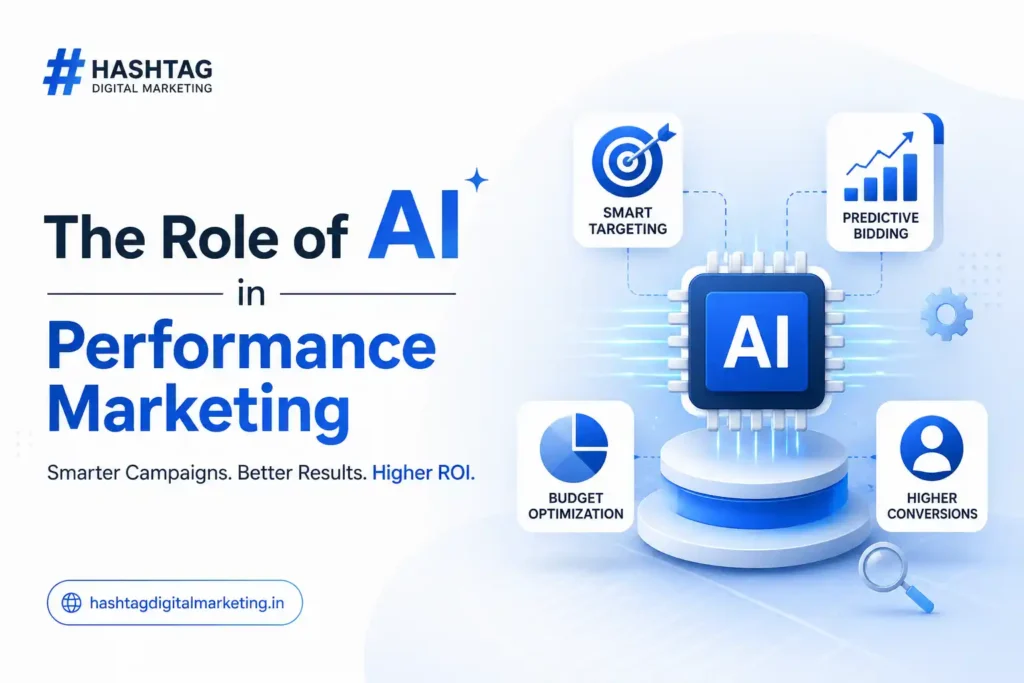
Performance marketing has always been about one thing: measurable results. Every rupee spent needs to justify itself through clicks, conversions, or revenue. For years, marketers relied on manual bidding, spreadsheet-based analysis, and gut instinct to hit their targets. That approach is fading fast.
The Role of AI in Performance Marketing has shifted from a nice-to-have experiment to the operating system behind most successful campaigns. Machine learning models now predict user behaviour, adjust bids in real time, and generate creative variations faster than any human team could manage manually.
For marketers and business owners trying to make sense of this shift, the question isn’t whether to adopt AI, but how to use it without losing strategic control. This article breaks down where AI genuinely helps, where it still needs human oversight, and what practical steps you can take to stay competitive in 2026’s search and advertising landscape.
What Is Performance Marketing in the AI-Driven Landscape
Performance marketing is a digital advertising approach where businesses pay only when a specific action is completed, such as a click, lead, purchase, app install, or another measurable conversion. Unlike traditional advertising, which often focuses on reach or impressions, performance marketing is built around measurable outcomes and return on investment (ROI). It includes channels such as paid search, social media advertising, affiliate marketing, display advertising, and programmatic campaigns, allowing marketers to track and optimize every stage of the customer journey.
Today, artificial intelligence has transformed how performance marketing campaigns are managed. Instead of relying on constant manual adjustments, modern advertising platforms use machine learning to analyze vast amounts of data and automatically optimize campaigns in real time. Marketers now achieve better results by providing high-quality inputs and clear business objectives rather than making frequent manual changes.
Key elements of AI-driven performance marketing include:
- Clear campaign goals, such as leads, sales, or revenue, to guide AI optimization.
- High-quality first-party data for more accurate audience targeting.
- Strong ad creatives and compelling copy that AI can test across multiple variations.
- Conversion tracking and analytics to help algorithms learn from user behavior.
- Continuous monitoring and strategic oversight to refine campaigns without disrupting AI’s learning process.
Predictive Bidding, Smarter Budgets, and Audience Targeting
AI-powered performance marketing uses predictive bidding, automated budget allocation, and intelligent audience targeting to maximize conversions, improve ad efficiency, reduce wasted spend, and deliver better ROI through real-time data analysis.
Predictive Bidding and Budget Allocation
Smart bidding strategies use historical conversion data, device signals, time of day, and even seasonal trends to predict which auctions are worth winning. Instead of manually adjusting bids every few days, marketers now set a target cost-per-acquisition or return-on-ad-spend, and the algorithm handles thousands of micro-adjustments per hour. This doesn’t mean bidding is fully hands-off, though. Campaigns still need a minimum threshold of conversion volume before automated bidding performs reliably, and accounts with low data volume often see inconsistent results until the system has enough signal to learn from.
Audience Targeting and Segmentation
Traditional targeting relied on broad demographic buckets. AI-driven targeting instead builds behavioural clusters based on browsing patterns, purchase intent signals, and lookalike modelling, allowing brands to reach people who resemble existing customers even if they’ve never interacted with the brand before.
A Quick Example: How Creative Testing Actually Plays Out
Consider a mid-sized e-commerce brand running a festive-season campaign. In the past, its team would manually design three or four ad variations and let them run for a week before checking results. Today, AI-assisted creative tools generate a dozen headline and image combinations at once, testing them simultaneously across audience segments. Within days, the system identifies which combination drives the strongest engagement, and budget shifts automatically toward the winners.
This kind of testing at scale is particularly valuable for brands with limited creative teams, where speed matters as much as polish. It doesn’t eliminate the need for good design judgment, but it removes the guesswork of deciding which variation to trust.
Why Search Visibility Looks Different Now
- Users increasingly get answers directly on the results page through AI Overviews, without clicking through to a website
- This changes how brands need to think about both organic and paid visibility together
- Marketers running campaigns on Google ads now need to consider structured, well-answered content alongside keyword bidding
- Content that directly and clearly answers user questions has a better chance of being referenced in AI-generated summaries
- Being cited in these summaries builds brand recall even when a click doesn’t happen immediately
This is where Generative Engine Optimisation, or GEO, becomes relevant. It’s the practice of structuring content so AI systems can understand, trust, and cite it accurately, rather than optimising purely for keyword density.
Where Human Oversight Still Matters
It’s tempting to treat AI as a set-and-forget solution, but that approach usually backfires.
Strategic goal-setting stays human. Algorithms optimise for whatever metric you give them, so a poorly defined goal, like raw clicks instead of qualified leads, leads to wasted spend.
Brand tone needs regular review. Automated creative generation can drift from brand voice if left unchecked for too long.
Data quality checks can’t be skipped. AI models are only as good as the tracking setup feeding them; broken pixels or misconfigured conversions quietly distort results over time.
Compliance requires judgment. Targeting decisions need to align with privacy regulations, which automated systems don’t always account for by default.
Marketers who treat AI as a collaborator rather than a replacement tend to see steadier, more sustainable results.
Bringing AI Into Your Marketing Stack, Step by Step
For businesses looking to adopt AI without overhauling their entire workflow, a phased approach works better than switching everything overnight.
- Begin with automation in reporting, since tools that consolidate cross-channel data into a single dashboard save hours of manual work
- Test smart bidding on a portion of your budget first, rather than switching an entire account at once
- Use AI primarily for research and pattern discovery, not final strategic decisions
- Invest in first-party data collection now, since AI models increasingly depend on it as third-party cookies phase out
- Review automated outputs weekly rather than assuming performance will hold steady without checks
Any solid performance marketing approach today treats AI as an accelerator for decisions that remain grounded in business context, not a replacement for strategic thinking. Teams pairing automated tools with clear KPIs and regular audits consistently outperform those who hand over control entirely.
Content, SEO, and the E-E-A-T Connection
Search engines now prioritize content quality, credibility, and user value over simple keyword optimization. Google’s emphasis on Experience, Expertise, Authoritativeness, and Trustworthiness (E-E-A-T) means businesses must create original, accurate, and in-depth content that genuinely answers user questions. Articles supported by real-world experience, industry expertise, case studies, statistics, and credible sources are more likely to earn higher rankings and appear in AI-powered search experiences, including AI Overviews. This shift makes topical authority and content relevance essential for long-term organic visibility.
Content strategy and performance marketing should work together rather than as separate efforts. High-quality SEO content strengthens landing pages by improving relevance, user engagement, and trust, which can positively influence paid advertising metrics such as Quality Score and conversion rates. When businesses combine valuable content with well-optimized paid campaigns, they create a consistent user journey that increases credibility, reduces acquisition costs, and improves overall marketing ROI.
Common Roadblocks Businesses Run Into
- Over-reliance on automation without understanding how AI makes decisions can make it difficult to identify and resolve performance issues when campaigns underperform.
- Growing data privacy regulations and user consent requirements limit the amount of customer data available for targeting and measurement.
- AI-powered campaigns often require a learning period before they can optimize effectively, which may lead to temporary fluctuations in performance.
- Limited budgets or insufficient conversion data can reduce the effectiveness of AI-driven bidding and optimization algorithms.
- Poor-quality or incomplete data can lead to inaccurate audience targeting and weaker campaign performance.
- Frequent campaign changes during the learning phase can reset optimization, delaying consistent results.
- Integrating AI tools with existing marketing platforms and analytics systems can require additional time and technical expertise.
- AI recommendations still need human oversight to ensure they align with business goals, brand messaging, and overall marketing strategy.
What This Means Going Forward
The future of performance marketing will be defined by greater Ai automation, but strategic planning, creative decision-making, and human oversight will remain critical. As AI takes over repetitive campaign management tasks, marketers who understand how these systems operate will be better equipped to optimize performance, resolve issues efficiently, and uncover growth opportunities that automated tools alone may overlook.
At the same time, search behavior is evolving with the rise of AI Overviews and conversational search experiences. Businesses must create content that is not only valuable and engaging for users but also structured for machine interpretation. Combining high-quality content, strong technical SEO, and AI-driven performance marketing will help brands improve visibility, enhance user trust, and achieve sustainable long-term growth.
Frequently Asked Questions
1. Is AI replacing performance marketers?
Not entirely. AI handles repetitive, data-heavy tasks like bid adjustments and audience segmentation, but strategic planning, creative direction, and ethical decision-making still require human judgment.
2. How does AI improve ROI in advertising campaigns?
AI improves ROI by processing far more data points than a human can manually track, allowing for faster, more precise adjustments to bids, targeting, and creative, often reducing wasted spend over time.
3. What is Generative Engine Optimisation, or GEO?
GEO refers to optimising content so it can be accurately understood and referenced by AI-driven search tools and generative answer engines, alongside traditional SEO practices.
4. Do small businesses need AI tools for performance marketing?
Not necessarily at an enterprise scale, but even basic automation features available within ad platforms can meaningfully reduce manual workload and improve targeting accuracy for smaller budgets.
5. How long does it take for AI-driven campaigns to show results?
Most automated bidding strategies need a learning period, generally a couple of weeks, along with sufficient conversion data, before performance stabilises and improves.
Final Thoughts
AI has fundamentally reshaped how campaigns are planned, executed, and optimised, but it hasn’t removed the need for strategic thinking. The brands seeing the strongest results are the ones combining AI’s speed and scale with clear business goals, quality content, and consistent human oversight.
If you’re looking to build a smarter, data-driven marketing strategy that balances automation with real expertise, our team at Hashtag Digital Marketing can help you navigate the shift without losing sight of what actually drives growth. Get in touch to review your current campaigns and identify where AI can genuinely move the needle for your business.
About the Author
Rohan Joshi is a director and digital marketing trainer at Hashtag Academy who believes in building skills through real-world application. With 8+ years of experience working across education, healthcare, and service industries, he helps students and businesses understand how digital strategies actually perform in live markets. His mission is to create confident professionals who can deliver measurable growth.