
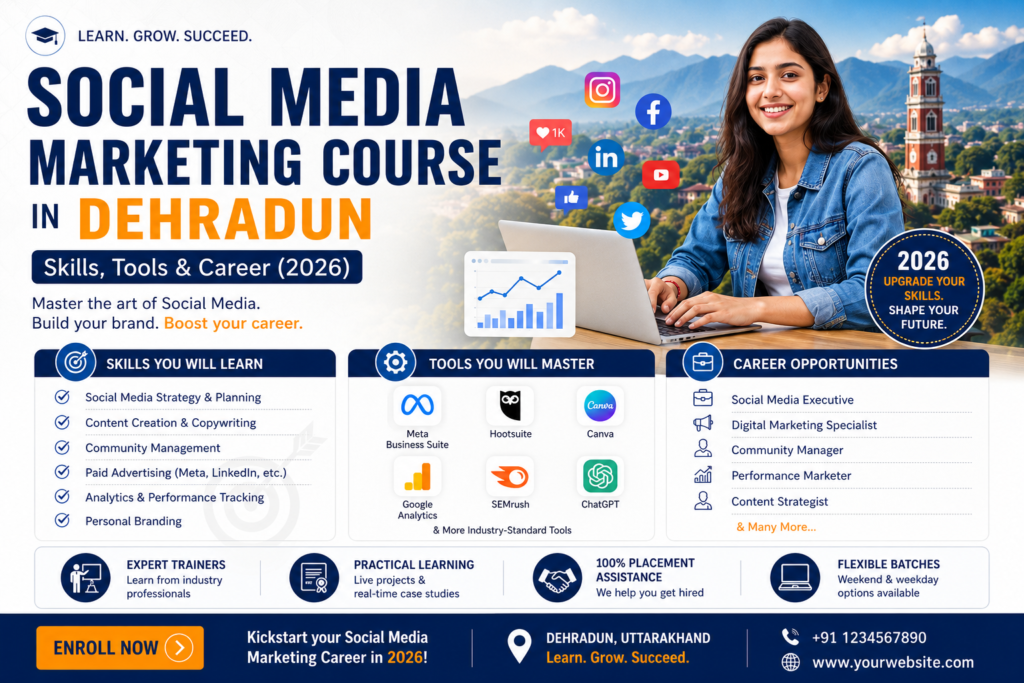
Social media is no longer a platform for casual connection — it is the primary battlefield where brands win or lose customers, where careers are built, and where businesses scale without spending a fortune on traditional advertising. If you are a student, a working professional, or an aspiring entrepreneur in Uttarakhand looking to build a future-proof skill, enrolling in a Social Media Marketing Course in Dehradun is one of the most impactful decisions you can make in 2026. The demand for trained social media professionals has grown sharply across industries — from e-commerce and education to hospitality and healthcare — and that demand shows no sign of slowing.
What separates a social media marketer who actually drives results from someone who simply posts content is strategic depth. Understanding platform algorithms, audience psychology, content calendars, paid amplification, and analytics reporting are not optional extras — they are the core competencies employers pay for. A structured course teaches you not just what to post, but why certain content works, when to publish it, how to measure its impact, and how to use that data to make smarter decisions next month.
Dehradun has steadily grown as a destination for quality digital education, and the social media marketing space is one of the most active areas of that growth. Local agencies are hiring, startups are expanding, and businesses of all sizes are investing in social-first marketing strategies. This guide walks you through every module of a comprehensive SMM curriculum, the tools and platforms you will master, the career paths that open up, and what you can realistically earn once you specialise.
Why Social Media Marketing Is the Most In-Demand Digital Skill in 2026
India now has over 800 million internet users, and a massive proportion of their online time is spent on Instagram, YouTube, Facebook, and LinkedIn. For businesses, this is not a trend — it is the new reality of consumer attention. Brands that do not have a strong, consistent, and strategic social media presence are invisible to their target audience.
For marketers, this translates to enormous opportunity. The number of Social Media Manager job listings in India has more than doubled in the past three years. Freelancers who specialise in Instagram growth or LinkedIn strategy command premium rates. Content Strategists and Community Managers are now full-time roles at companies that previously did not even have a dedicated social media team.
The skills gap is still significant — there are far more businesses that need social media expertise than there are trained professionals to provide it. A structured, module-specific education puts you on the right side of that gap.
The Full Social Media Marketing Curriculum — Module by Module
Module 1: Foundations of Social Media Marketing
Every strong SMM education begins with strategic foundations. This module covers how social media fits within the broader digital marketing funnel, the differences between organic and paid social, how platform algorithms work across Instagram, Facebook, LinkedIn, and YouTube, and how to define social media goals that align with actual business objectives — awareness, engagement, lead generation, or direct sales.
Students learn to conduct a social media audit of an existing brand, identify content gaps, and benchmark performance against competitors. Setting up a professional Business Manager account, linking pages and ad accounts, and understanding audience insights tools are all covered in this foundational module.
Module 2: Instagram Organic Growth Strategy
Instagram remains the dominant visual platform for brands targeting consumers between 18 and 45, and mastering its organic growth levers is a core SMM skill. This module covers profile optimisation — bio writing, highlight strategy, link-in-bio tools — as well as content formats: feed posts, carousels, Reels, Stories, and Lives.
Students learn how the Instagram algorithm distributes content, what signals it prioritises (saves, shares, watch time, comments), and how to structure a content strategy that feeds those signals deliberately. Hashtag research, caption writing for engagement, posting cadence, and collaboration strategies (joint Reels, brand tags) are explored with real-brand case studies. Growth benchmarks and how to interpret your Instagram Insights are a core part of practical assignments.
Module 3: LinkedIn Strategy for B2B and Personal Branding
LinkedIn has transformed from a job board into the most powerful B2B content platform in the world. This module teaches students how to build and optimise a LinkedIn profile for visibility, how to write long-form posts and newsletters that generate meaningful reach, and how to use LinkedIn’s algorithm — which still rewards text-heavy, insight-driven posts significantly more than other platforms do.
Students learn the difference between a personal brand strategy and a company page strategy on LinkedIn, how to engage authentically in a way that builds authority rather than noise, and how to use LinkedIn for lead generation — both organically and as a complement to paid LinkedIn campaigns. This module is particularly valuable for students targeting B2B roles or planning to build a freelance consulting practice.
Module 4: YouTube Shorts and Video Content Strategy
Short-form video is the fastest-growing content category across every platform, and YouTube Shorts has emerged as a serious competitor to Instagram Reels and TikTok. This module covers the fundamentals of video content strategy — how to structure a short-form video for maximum watch time, how to write hooks that stop the scroll in the first two seconds, and how to repurpose long-form YouTube content into Shorts efficiently.
Students also learn the basics of YouTube channel optimisation — titles, descriptions, tags, thumbnails, and playlists — and how to use YouTube Analytics to understand audience retention and traffic sources. The module introduces basic video editing tools including CapCut and Adobe Premiere Rush, which are industry-standard for social video production.
Module 5: Meta Ads Manager — Paid Social Advertising
Organic reach on Facebook and Instagram has declined significantly over the past several years, making paid amplification through Meta Ads Manager a non-negotiable skill for any complete social media marketer. This module provides a comprehensive introduction to running paid campaigns across Facebook and Instagram.
Students learn the Meta campaign structure — campaigns, ad sets, and ads — and how to configure each level for their objective. Audience targeting is covered in depth: core audiences, custom audiences (website visitors, customer lists, video viewers), and lookalike audiences. Students run live campaigns on small budgets, test creative formats (single image, carousel, video, collection ads), and analyse results using Ads Manager reporting.
The module also covers the Meta Pixel and Conversions API setup, understanding ad delivery and frequency, A/B testing frameworks, and how to scale a winning ad set without destroying its performance. This is one of the most practically intensive modules in the curriculum and directly feeds into job-ready skills for agency and in-house roles alike.
Module 6: Content Calendar Creation and Strategy
Consistency is the single most underrated factor in social media success, and a well-built content calendar is the system that makes consistency achievable. This module teaches students how to build a monthly and quarterly content calendar from scratch — mapping content pillars, planning campaigns around key dates and product launches, balancing promotional and value-adding content, and building approval workflows for team environments.
Students work with tools including Notion, Google Sheets, and Trello for calendar management, and scheduling tools including Buffer, Later, and Meta Business Suite for automated publishing. The module includes a live project where students build a complete four-week content calendar for a real or simulated brand brief.
Module 7: Influencer Marketing — Strategy and Execution
Influencer marketing has matured from a novelty into a structured, measurable marketing channel. This module covers how to identify the right influencers for a brand — the difference between mega, macro, micro, and nano influencers, and when each tier is appropriate. Students learn how to evaluate an influencer’s audience quality (not just follower count), how to negotiate briefs and usage rights, and how to structure an influencer campaign with clear deliverables, timelines, and KPIs.
The module also covers how to track influencer campaign performance using UTM links, promo codes, and platform-native insights, and how to build long-term ambassador relationships rather than one-off sponsored posts. Real campaign examples from Indian brands across fashion, food, and technology are used throughout.
Module 8: Analytics, Reporting, and Performance Measurement
Data literacy is what separates a strategic social media marketer from a content creator. This module teaches students how to build meaningful performance reports across platforms — Instagram Insights, LinkedIn Analytics, YouTube Studio, Facebook Page Insights, and Meta Ads Manager reporting — and how to present those findings to clients or internal stakeholders in a way that connects social activity to business outcomes.
Students learn to define platform-specific KPIs (reach, impressions, engagement rate, follower growth, click-through rate, cost per result), identify trends across reporting periods, and use that data to make informed decisions about what content to double down on and what to retire. Google Analytics 4 integration with social traffic is also covered, giving students a full-funnel view of how social media drives website behaviour and conversions.
AI Tools for Social Media Marketers — The New Competitive Edge
The social media marketing landscape in 2026 is being reshaped by artificial intelligence, and professionals who learn to work with AI tools have a significant productivity and creative advantage over those who do not.
AI tools are now being used to generate first-draft captions, repurpose long-form content into short-form social posts, analyse engagement patterns, automate comment responses, and schedule content intelligently based on audience activity data. Beyond content creation, automation platforms like Zapier and Make (formerly Integromat) allow social media managers to connect their tools — CRMs, scheduling platforms, reporting dashboards, and client communication systems — into seamless automated workflows that save hours every week.
If you want to go deep into this space, the AI Build Automations course at Hashtag Digital Marketing Academy teaches you how to master Claude AI combined with Zapier and Make to build real automation systems — no coding required. This is particularly powerful for freelancers who want to scale their client work without scaling their hours, and for agency professionals who want to deliver faster, more consistent results. In 2026, knowing how to automate your workflow is not a bonus — it is a professional baseline.
Platform-Specific Certification Options
Beyond a structured course, certifications add credibility to your profile and signal commitment to continuous learning. Here are the most recognised options:
Meta Blueprint Certifications — Meta’s official certification programme covers Digital Marketing Associate, Marketing Science Professional, and Creative Strategy Professional credentials. The Digital Marketing Associate exam is the most accessible starting point and is widely recognised by agencies that run Facebook and Instagram campaigns.
HubSpot Social Media Marketing Certification — A free, well-structured certification covering social strategy, content creation, and social advertising fundamentals. Particularly useful if you plan to work in inbound marketing or content-led roles.
Hootsuite Social Media Marketing Certification — Covers platform strategy, content planning, community management, and analytics. Recognised by a large number of digital agencies globally.
LinkedIn Marketing Labs Certifications — Platform-specific credentials for LinkedIn marketing, particularly valuable for B2B-focused roles and anyone planning to specialise in LinkedIn strategy or LinkedIn Ads.
Google Analytics 4 Certification (via Skillshop) — An essential complement to any SMM certification, since GA4 is the standard tool for understanding how social traffic converts on a website.
Career Paths After a Social Media Marketing Course
Social Media Manager
A Social Media Manager owns the organic and sometimes paid social presence of a brand or a portfolio of client accounts. Responsibilities include content planning and creation, community management, influencer coordination, and monthly performance reporting. In agencies, Social Media Managers often handle multiple clients across different industries simultaneously.
Salary range in India (2026): ₹3.5 LPA – ₹7 LPA for 1–2 years of experience; ₹7 LPA – ₹14 LPA for senior managers at established brands or large agencies.
Content Strategist
A Content Strategist works at a higher level of abstraction than a Social Media Manager — defining the overall content direction, brand voice, content pillars, and editorial calendar strategy rather than executing individual posts. This role often bridges social media, SEO, and email marketing, and is well-suited to those who combine strong writing ability with analytical thinking.
Salary range in India (2026): ₹4.5 LPA – ₹9 LPA at mid-level; ₹10 LPA – ₹18 LPA for senior content strategists at growth-stage companies.
Community Manager
Community Managers focus on building and nurturing engaged audiences around a brand — responding to comments and DMs, moderating Facebook Groups or Discord servers, identifying brand advocates, and turning followers into loyal customers. This is a relationship-first role that requires empathy, quick thinking, and deep product knowledge.
Salary range in India (2026): ₹3 LPA – ₹6 LPA at entry level; higher at tech companies and consumer brands with large, active communities.
Freelance Social Media Consultant
Many SMM specialists in Dehradun choose the freelance route, managing accounts for local restaurants, fitness studios, real estate agencies, educational institutions, and e-commerce brands. A freelancer managing 3–5 accounts at ₹10,000 – ₹30,000 per account per month builds a strong independent income with high flexibility.
How Dehradun Businesses Are Driving Demand for SMM Talent
The growth of Local Businesses in Dehradun across sectors like hospitality, adventure tourism, real estate, retail, and education has created genuine, sustained demand for social media professionals who understand the local market while being capable of executing at a national standard. Restaurants need Instagram-first content strategies. Hotels need YouTube and Google presence. Educational institutes need LinkedIn and Facebook campaigns. Real estate developers need Meta Ads to generate qualified leads.
This creates a unique opportunity for SMM graduates in Dehradun — you do not need to relocate to a metro city to find your first client or your first job. The local market is active, underserved, and willing to pay for results-driven social media management.
How SMM Fits Within a Broader Digital Marketing Education
Social media marketing is a powerful standalone skill, but it becomes even more effective when combined with complementary disciplines — SEO for organic discoverability, Google Ads for paid search, email marketing for nurture sequences, and analytics for full-funnel measurement. If you want to understand how SMM fits within the complete picture of paid and organic digital strategy, exploring a Digital Marketing Course in Dehradun gives you that broader framework while still allowing you to specialise in social media as your primary expertise.
The most employable professionals in 2026 are not generalists who know a little about everything — they are T-shaped marketers who have gone deep in one discipline (like social media marketing) while maintaining enough cross-channel literacy to collaborate effectively with SEO specialists, paid media teams, and content writers.
What to Look for in a Social Media Marketing Course in Dehradun
Is the curriculum platform-current? Instagram, LinkedIn, and Meta Ads all update their features, algorithms, and interfaces regularly. A course built on 2022 knowledge will leave you behind from day one.
Does it include hands-on Meta Ads Manager training? Organic-only courses leave a major gap. Paid social is inseparable from modern SMM practice.
Is analytics and reporting included? Many courses focus on creation and scheduling but skip measurement. Data literacy is what makes you hireable.
Do you get live project experience? Portfolio pieces — real content calendars, campaign screenshots, analytics reports — matter far more than certificates alone when applying for your first role.
Are instructors active practitioners? Look for educators who are managing real brand accounts and live ad budgets today, not those who last worked in the field several years ago.
Conclusion
Social media marketing is one of the few digital skills where creative ability, strategic thinking, and data analysis converge into a single, measurable, high-demand profession. The curriculum outlined in this guide — spanning Instagram organic growth, LinkedIn strategy, YouTube Shorts, Meta Ads Manager, content calendar creation, influencer marketing, and analytics reporting — represents a complete and current education in social media marketing. For learners in Uttarakhand, completing a structured social media marketing course in Dehradun means building this expertise within a local ecosystem that increasingly rewards it, without the disruption and expense of relocating to a larger city.
Whether your goal is a salaried role as a Social Media Manager or Content Strategist, a freelance practice serving local and national clients, or a broader career in performance marketing, social media skills compound over time. Every campaign you run sharpens your instincts, every analytics report you build deepens your strategic thinking, and every result you deliver for a client or employer becomes a portfolio piece that opens the next door. The investment in this skill is not just about where you start — it is about where the trajectory takes you.
About the Author
Rohan Joshi is a director and digital marketing trainer at Hashtag Academy who believes in building skills through real-world application. With 8+ years of experience working across education, healthcare, and service industries, he helps students and businesses understand how digital strategies actually perform in live markets. His mission is to create confident professionals who can deliver measurable growth.