
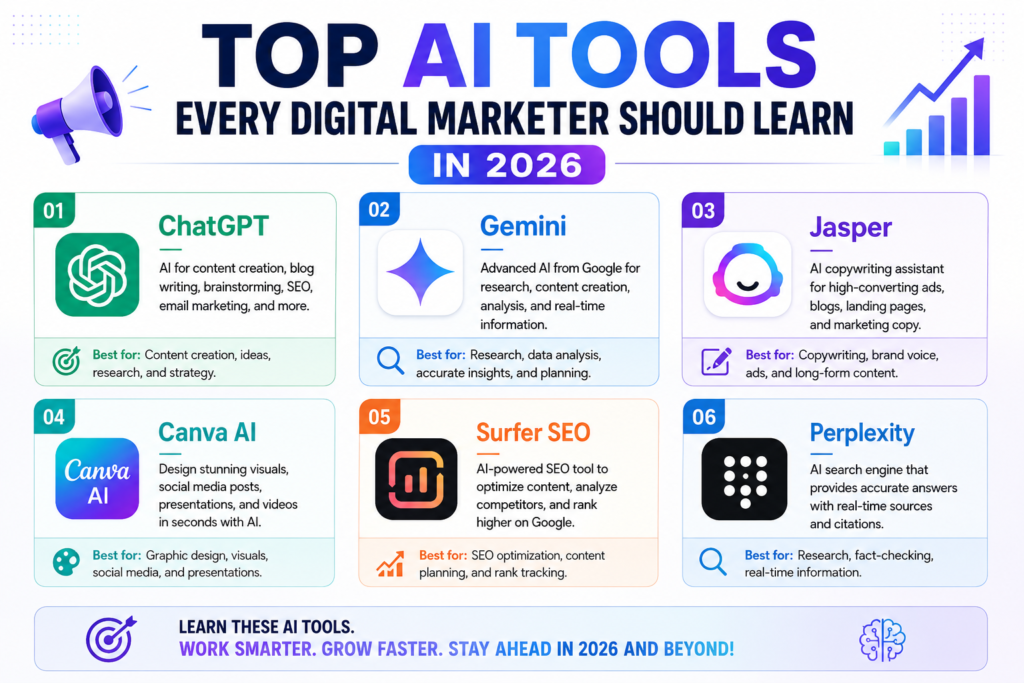
The marketing landscape has never changed faster than it is changing right now. Artificial intelligence has moved from being a buzzword in tech conferences to a daily working tool sitting inside browsers, dashboards, and creative suites. If you are a marketer wondering where to start, the answer is already being searched millions of times every month — AI Tools for Digital Marketing 2026 — ChatGPT & Beyond is one of the fastest-growing query clusters on Google, and for good reason. Marketers who understand these tools are getting campaigns done in hours that used to take weeks.
But knowing that AI matters and knowing which tools to learn are two very different things. The market is flooded with products making bold promises, and it can feel impossible to separate the tools that will genuinely move the needle from the ones that are little more than polished hype. In 2026, a handful of platforms have proven themselves inside real agency workflows, brand teams, and freelance practices. This blog focuses exclusively on those tools — the ones that experienced professionals are actually using to write copy, research keywords, generate visuals, and interpret campaign data.
This is not a surface-level list. Each tool covered below comes with a clear explanation of how marketers use it in practice, what it does well, and where human judgment still has no substitute. Whether you are a student stepping into the industry for the first time or a working professional looking to future-proof your skills, this guide gives you a concrete, honest picture of what AI proficiency looks like in 2026 — and how to build it.
Why AI Literacy Is Now a Core Marketing Skill
A few years ago, AI proficiency was a nice-to-have on a resume. Today, it is fast becoming a baseline expectation, much like knowing how to use Google Analytics or Meta Ads Manager. Agencies are building internal AI workflows, brands are cutting production timelines dramatically, and clients expect faster turnarounds with higher content volumes than human-only teams can deliver.
The marketers who are thriving are not those who have handed their work over to AI. They are the ones who have learned to direct it — feeding it smart prompts, reviewing its output critically, editing it with brand voice in mind, and combining it with the strategic thinking that no model can replicate. AI is a force multiplier, not a replacement, and understanding that distinction is where real competency begins.
The Six AI Tools That Actually Matter in 2026
1. ChatGPT — The Thinking Partner for Content and Strategy
ChatGPT remains the most versatile tool in a marketer’s AI stack. In 2026, it is being used not just for drafting content but for structured strategic thinking. Marketers use it to build content briefs from scratch, develop audience personas, stress-test campaign ideas, and generate multiple ad copy variations in a single session.
How professionals use it:
- Writing detailed content briefs that include target audience, search intent, key talking points, and suggested structure
- Generating 10 to 15 variations of ad copy headlines for A/B testing
- Summarising lengthy research reports into actionable bullet points
- Drafting email sequences with different tones for different buyer stages
- Creating FAQ sections and meta descriptions at scale
The key to getting real value from ChatGPT is prompt quality. Vague prompts produce generic output. Specific, context-rich prompts — ones that include the brand voice, the target audience, the goal of the piece, and what to avoid — produce output that requires far less editing. Learning to write those prompts is itself a skill that separates competent AI users from advanced ones.
2. Google Gemini — Research, Multimodal Work, and Ad Integration
Google’s Gemini has become the go-to tool for marketers who live inside the Google ecosystem. Its deep integration with Google Workspace, Google Search, and Google Ads makes it particularly powerful for teams running search and display campaigns.
How professionals use it:
- Pulling competitor insights and summarising them from live search data
- Drafting responsive search ad copy that aligns with landing page content
- Generating keyword expansion ideas directly from campaign performance data
- Creating structured reports by pulling data from Google Sheets via Gemini’s integration
For anyone running or studying paid search, Gemini’s ability to interpret live data and generate copy simultaneously is a significant workflow advantage. If you are enrolled in a course that covers paid search, such as a Google Ads in Dehradun training programme, learning Gemini alongside the ad platform itself gives you a practical edge that purely theoretical study cannot replicate.
3. Jasper AI — Built Specifically for Marketing Copy
While ChatGPT is a general-purpose model, Jasper was built from the ground up for marketing teams. It comes pre-loaded with templates for blog posts, product descriptions, social captions, email subject lines, and press releases. In 2026, its brand voice training feature has become one of its most used capabilities — teams feed it existing approved content, and it learns to write in that style consistently.
How professionals use it:
- Maintaining brand voice consistency across large content teams
- Generating long-form blog drafts from a content brief in minutes
- Running parallel campaigns in multiple tones (corporate, casual, urgent) to test audience response
- Creating product description variations for e-commerce catalogues at scale
Jasper is particularly useful in agency environments where multiple writers need to produce content that sounds like it came from the same brand. The brand voice feature reduces editing time and helps junior writers produce on-brand work faster.
4. Canva AI — Visual Content at Scale
Canva has always been the accessible design tool for non-designers, and in 2026 its AI features have made it genuinely powerful for content production. The Magic Studio suite — which includes AI image generation, background removal, text-to-image, and AI-assisted design resizing — has become a standard part of social media workflows.
How professionals use it:
- Generating on-brand social media graphics using text prompts
- Resizing a single design into every social platform format in seconds
- Creating presentation decks with AI-suggested layouts based on content
- Producing video thumbnails, story templates, and carousel posts at volume
For marketers managing social media, Canva AI has dramatically reduced the dependency on dedicated design resources. A non-designer can now produce polished carousels, story templates, branded graphics, and video thumbnails without touching a single manual design tool. If you are building skills in social media management — through a structured Social Media Marketing Course in Dehradun — learning Canva AI as part of your training ensures you enter the workforce with a tool that agencies and brand teams are already using daily in their production workflows.
5. Surfer SEO — AI-Powered Content Optimisation
Surfer SEO has become the industry standard for content teams focused on organic search performance. It analyses the top-ranking pages for any keyword and produces a data-driven content outline — telling you how long the content should be, which semantic keywords to include, how many headings to use, and what questions to answer.
How professionals use it:
- Generating content outlines for blog posts before writing begins
- Auditing existing content and identifying gaps causing poor rankings
- Clustering keywords into topic groups for pillar-and-cluster content strategies
- Scoring content in real time as writers work inside the Surfer editor
What makes Surfer SEO particularly valuable is that it takes much of the guesswork out of content strategy. Instead of debating word count or heading structure, writers follow a data-backed blueprint. Combined with ChatGPT for drafting and a human editor for final voice and accuracy, it creates a fast, reliable content production pipeline.
6. Perplexity AI — Research Without the Rabbit Holes
Perplexity AI has emerged as a serious research tool for marketers who need accurate, cited information quickly. Unlike a standard search engine, Perplexity synthesises answers from multiple sources and shows exactly where each fact comes from. In 2026, it is being used heavily for competitor research, industry trend analysis, and fact-checking content before publication.
How professionals use it:
- Researching industry statistics with source citations for blog posts and whitepapers
- Tracking competitor positioning and messaging changes
- Staying updated on algorithm changes, platform updates, and industry news
- Generating research summaries for client reports without reading 12 separate articles
Perplexity is particularly valuable for agencies that produce a high volume of thought leadership content. It reduces research time dramatically while maintaining the citation rigour that credible content requires.
How to Actually Use These Tools Together: A Real Workflow
Knowing individual tools is one thing. Understanding how they connect into a working process is what separates someone who has experimented with AI from someone who has operationalised it.
Here is a sample workflow a content marketer might use to produce an SEO-optimised blog post:
- Perplexity — Research the topic, gather statistics, identify what top competitors are covering
- Surfer SEO — Generate a keyword-driven content outline with semantic structure
- ChatGPT — Draft the post section by section using the outline as a prompt scaffold
- Jasper — Refine the introduction and conclusion to match brand voice guidelines
- Canva AI — Generate featured images, pull quotes, and social sharing graphics
- Human editor — Review for accuracy, strategic alignment, and voice consistency
This workflow takes a piece of content from blank page to publish-ready in a fraction of the time a purely human process would require — without sacrificing quality when each step is done with intention.
Marketers who understand this kind of integrated approach are the ones being hired and promoted in 2026. If you are looking to build this kind of practical, tool-integrated skill set, a comprehensive Digital Marketing Course in Dehradun that includes hands-on AI tool training is one of the most direct paths to getting there.
The Skills AI Cannot Replace
It would be dishonest to write a guide about AI tools without being clear about what they still cannot do. Understanding these limits is not pessimism — it is strategic awareness that helps you position yourself correctly in the market.
Strategic thinking. AI can generate options, but it cannot decide which option aligns with a brand’s long-term positioning, a client’s risk tolerance, or a market’s emotional readiness. Strategy requires contextual judgment that no model currently possesses.
Client communication and relationship management. Presenting campaign results, navigating client concerns, negotiating budget changes, and building long-term trust are deeply human skills. AI can help you prepare for these conversations, but it cannot have them for you.
Creative direction. AI can produce creative output, but someone still needs to evaluate whether that output is original, on-brand, emotionally resonant, and culturally appropriate. That curatorial eye is a human capability.
Ethical judgment. Marketers regularly face decisions about what to amplify, how to frame sensitive topics, and when a campaign concept crosses a line. These are judgment calls that require values — something AI does not have.
Adaptability in crisis. When a campaign goes wrong, when a platform changes overnight, or when a client faces a PR issue, the response must be fast, contextual, and nuanced. AI is a useful resource in those moments, but leadership in a crisis is irreducibly human.
How to List AI Proficiency on Your Resume
As AI skills become more expected, listing them effectively on a resume matters. Here is how to do it clearly and credibly:
In your skills section: List specific tools, not vague claims. “AI tools” means nothing. “ChatGPT prompt engineering, Surfer SEO content optimisation, Canva AI design, Jasper brand voice training” means something.
In your experience bullets: Connect tool use to outcomes. “Used Surfer SEO to optimise 30 blog posts, resulting in a 40% increase in organic traffic over six months” is far more compelling than “used AI tools to improve SEO.”
In your summary: A single sentence is sufficient. Something like: “Digital marketer with hands-on proficiency in AI content, SEO, and design tools including ChatGPT, Surfer SEO, and Canva AI” signals awareness without overstatement.
What to avoid: Do not claim expertise with tools you have only used once. Interviewers and hiring managers in 2026 are increasingly AI-literate themselves and will ask follow-up questions. Honest, specific proficiency always outperforms inflated generalisation.
Conclusion
AI tools are not the future of digital marketing — they are the present. The marketers succeeding in 2026 are not those waiting to see how things develop. They are the ones who chose a small set of tools, learned them deeply, integrated them into real workflows, and kept their irreplaceable human skills sharp alongside them. The six tools covered in this guide — ChatGPT, Gemini, Jasper, Canva AI, Surfer SEO, and Perplexity — represent a practical, proven starting point for any marketer serious about staying relevant.
Start with one. Build a workflow around it. Add the next. Within a few months, you will not just be more productive — you will think about marketing differently, see more possibilities in every brief, and bring a kind of structured creativity to your work that neither pure human effort nor pure AI output can match on its own. That combination is where the real opportunity lives in 2026, and it is entirely learnable.
About the Author
Rohan Joshi is a director and digital marketing trainer at Hashtag Academy who believes in building skills through real-world application. With 8+ years of experience working across education, healthcare, and service industries, he helps students and businesses understand how digital strategies actually perform in live markets. His mission is to create confident professionals who can deliver measurable growth.