
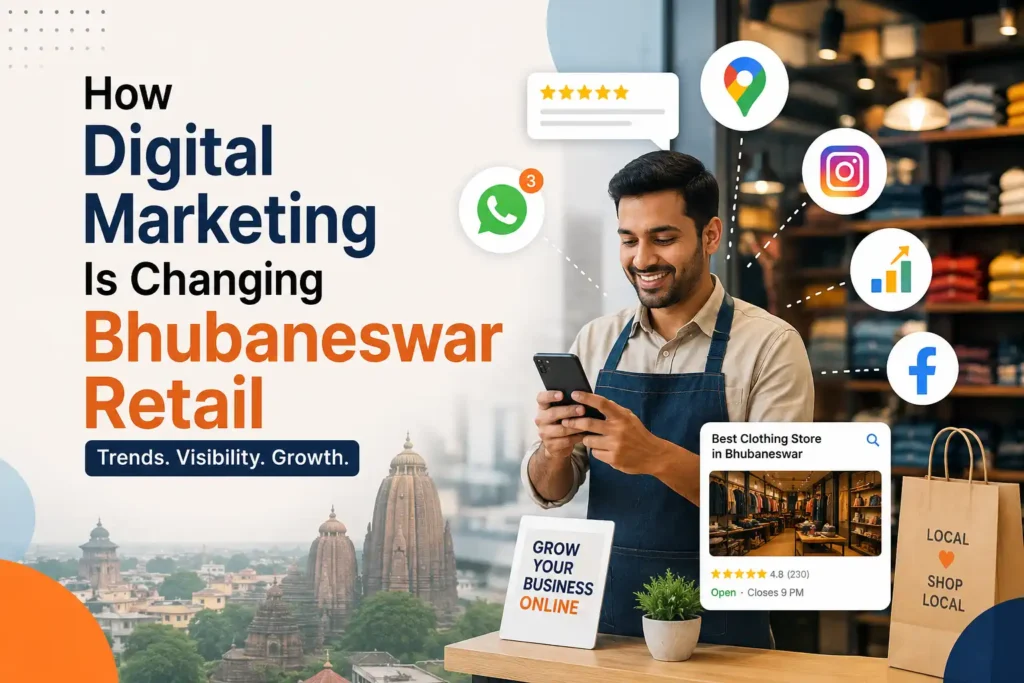
The way people discover and shop from local businesses in Bhubaneswar has changed dramatically. Whether someone is looking for a clothing boutique, grocery store, salon, electronics shop, or café, their journey often starts with a Google search, Google Maps, Instagram, or WhatsApp instead of a walk through the market. As more consumers rely on digital channels to compare options, read reviews, and contact businesses, local retailers can no longer depend solely on foot traffic and word-of-mouth.
The retail landscape in Bhubaneswar is becoming increasingly digital as more consumers search online before visiting a local business. From discovering shops on Google Maps to engaging with brands through Instagram and WhatsApp, digital platforms now play a major role in influencing buying decisions. How Digital Marketing Is Changing Bhubaneswar Retail is evident in the way local businesses are improving their online visibility, building customer trust, and turning digital interactions into in-store sales. As the city continues to grow as a commercial and technology hub, retailers that embrace digital marketing are better positioned to attract customers, increase loyalty, and stay ahead of the competition.
Why Bhubaneswar Retail Is Ready for This Shift
Bhubaneswar has grown well beyond its identity as Odisha’s administrative and temple city. It’s now home to a thriving IT and startup ecosystem, with Infocity and Chandaka IT Park housing hundreds of companies and thousands of working professionals — people who shop, order food, and discover local businesses primarily through their phones. Add to this a large student population from KIIT, IIIT Bhubaneswar, SOA University, Utkal University, and NISER, and you have a city full of digitally native customers who expect businesses to have an online presence.
The numbers support this. Odisha’s digital economy activity is growing at over 35% year-on-year, part of a larger national push toward a $1 trillion digital economy by 2030. For a retail shop owner, this isn’t an abstract statistic — it shows up directly as more customers searching “near me,” comparing shops on Google before visiting, and expecting to see a business on Instagram or WhatsApp before they trust it.
Old Approach vs. Digital-First Approach: What’s Actually Changing
| What Shop Owners Used to Rely On | What’s Working Now |
| Location and signboard visibility | Google Business Profile visibility in local search & maps |
| Word-of-mouth referrals | Customer reviews and star ratings online |
| Printed flyers and pamphlets | Instagram/Facebook posts and reels |
| Walk-in-only customer relationships | WhatsApp Business broadcasts and catalogs |
| One-time festival banners | Planned digital campaigns around Rath Yatra, Puja, Bali Jatra |
| Passive shop presence | Active, regularly updated online profiles |
| Generic city-wide advertising | Neighborhood-targeted local SEO (Patia, Chandrasekharpur, etc.) |
The pattern is consistent: customers haven’t stopped valuing good products or service — they’ve just changed where they look first before deciding to visit.
Google Business Profile: The New Shop Window
A large share of “foot traffic” in Bhubaneswar today actually starts as search traffic. A customer looking for a tailor in Patia, a bakery in Saheed Nagar, or an electronics repair shop in Chandrasekharpur is far more likely to search on Google first than to simply walk around looking.
A well-maintained Google Business Profile directly affects whether a shop shows up in the local map pack — the three listings Google displays above regular search results. A few things separate shops that get discovered from those that don’t:
- Complete, accurate business hours and location pin
- Regular photo uploads of products, staff, and storefront
- Prompt, polite responses to customer reviews
- Weekly posts or updates through the Google profile
- Consistent business name, address, and phone number across listings
Shops that treat this as an ongoing habit — not a one-time setup — consistently outperform competitors nearby.
Social Media as the New Storefront
For younger consumers in Bhubaneswar, especially students and IT professionals, Instagram and Facebook function less like marketing channels and more like storefronts. A clothing boutique posting daily reels of new arrivals, a café sharing behind-the-scenes content, or a furniture store showcasing real customer homes builds a kind of trust a static signboard can’t.
WhatsApp Business has also quietly become a powerful, low-cost customer relationship tool. Shop owners are using it to:
- Send broadcast alerts for new stock or restocks
- Share digital catalogs customers can browse before visiting
- Run limited-time festival offers directly to repeat customers
- Answer product questions instantly, without needing a website
Festivals and Local Culture Are Driving Digital Campaigns
One area where Bhubaneswar retail stands apart from generic national trends is how deeply local culture shapes digital marketing calendars. Rath Yatra, Durga Puja, and Bali Jatra aren’t just cultural events — they’re major commercial moments where local shops run targeted offers and festival-themed content. Retailers who plan digital campaigns around these local occasions consistently see stronger engagement than those relying on generic, non-localized content.
This same localization principle applies to Odisha’s handicraft and handloom sector. Sambalpuri sarees, Pattachitra art, and other traditional products have found new markets by pairing authentic craftsmanship with digital storytelling — high-quality product photography, artisan backstories, and targeted social ads reaching buyers well beyond Odisha’s borders.
Local SEO: The Advantage Most Shops Are Still Missing
Local SEO goes beyond just having a Google listing. It includes:
- Consistent business details (name, address, phone number) across directories
- Location-specific keywords tied to actual neighborhoods
- Content and listings that speak to a specific area, not just “Bhubaneswar” broadly
For example, a shop targeting customers in Patia benefits more from being discoverable for “shop near Patia Bhubaneswar” than from competing city-wide against every retailer in town. This geo-targeted approach is exactly what separates retailers who are visible online from those who remain invisible despite having a good product.
Who Else Is Driving This Shift Locally
Retail isn’t adapting in isolation — it mirrors a broader pattern across Bhubaneswar’s economy:
- Healthcare brands and hospital chains investing in local search visibility
- Tourism and hospitality businesses tied to Odisha Tourism building online booking presence
- E-commerce sellers expanding beyond the city through paid ads
- Educational institutions competing for student attention through content and social media
Retail shop owners who study how these sectors are adapting often find practical, transferable lessons — particularly around building trust through reviews and maintaining a consistent online presence.
This growing local demand has also fueled interest in structured learning. Many small business owners in the city are now exploring a digital marketing course in Bhubaneswar specifically to manage their own online presence — Google Business Profile, basic social media strategy, and simple ad campaigns — rather than depending entirely on external agencies for every task.
What This Means Going Forward
The businesses seeing the strongest results aren’t necessarily spending the most money — they’re the ones staying consistent. A regularly updated Google Business Profile, a social media presence showing real products and real people, and a willingness to engage with customer reviews and messages tend to outperform occasional, high-budget campaigns.
For shop owners still relying purely on walk-in traffic, the opportunity is simple: Bhubaneswar’s customers are already online, already searching, and already comparing options before deciding where to spend. Meeting them there is no longer optional — it’s how retail works in the city now.
Frequently Asked Questions
1. Do small shops in Bhubaneswar really need Google Business Profile?
Yes. Since a large share of local searches show Google’s map pack results first, an incomplete or missing profile means shops are effectively invisible to nearby customers actively looking to buy.
2. Is social media marketing necessary for a small retail shop, or just for big brands?
Small shops benefit significantly, especially with younger and IT-sector customers in Bhubaneswar who often discover local businesses through Instagram or Facebook before visiting in person.
3. How can a shop owner start learning digital marketing without a technical background?
No prior marketing or technical experience is required. Many local business owners begin with foundational learning through a digital marketing course in Bhubaneswar that covers practical basics like Google Business Profile setup, social media posting, and simple local SEO.
4. What’s the biggest digital marketing mistake local shops make?
Treating their online presence as a one-time setup rather than an ongoing effort — an unclaimed or outdated Google listing, inactive social pages, and no response to customer reviews are common gaps that competitors can easily exploit.
Summary
Bhubaneswar’s retail and local shop scene is shifting from foot-traffic-first to search-traffic-first. Driven by the city’s IT corridor (Infocity, Chandaka), a large student population, and 35%+ YoY growth in Odisha’s digital economy, customers now discover and vet local shops through Google Business Profile, Instagram/Facebook, and WhatsApp Business before ever walking in.
The blog covers a before/after comparison table of old vs. digital-first retail habits, practical checklists for GBP and WhatsApp, how local festivals (Rath Yatra, Puja, Bali Jatra) and handicraft businesses are using digital storytelling, why neighborhood-level local SEO beats generic city-wide targeting, and how other sectors (healthcare, tourism, e-commerce) are adapting in parallel — closing with an FAQ section and one natural mention of “digital marketing course in Bhubaneswar” for shop owners wanting to manage their own presence.
About the Author
Rohan Joshi is a director and digital marketing trainer at Hashtag Academy who believes in building skills through real-world application. With 8+ years of experience working across education, healthcare, and service industries, he helps students and businesses understand how digital strategies actually perform in live markets. His mission is to create confident professionals who can deliver measurable growth.