
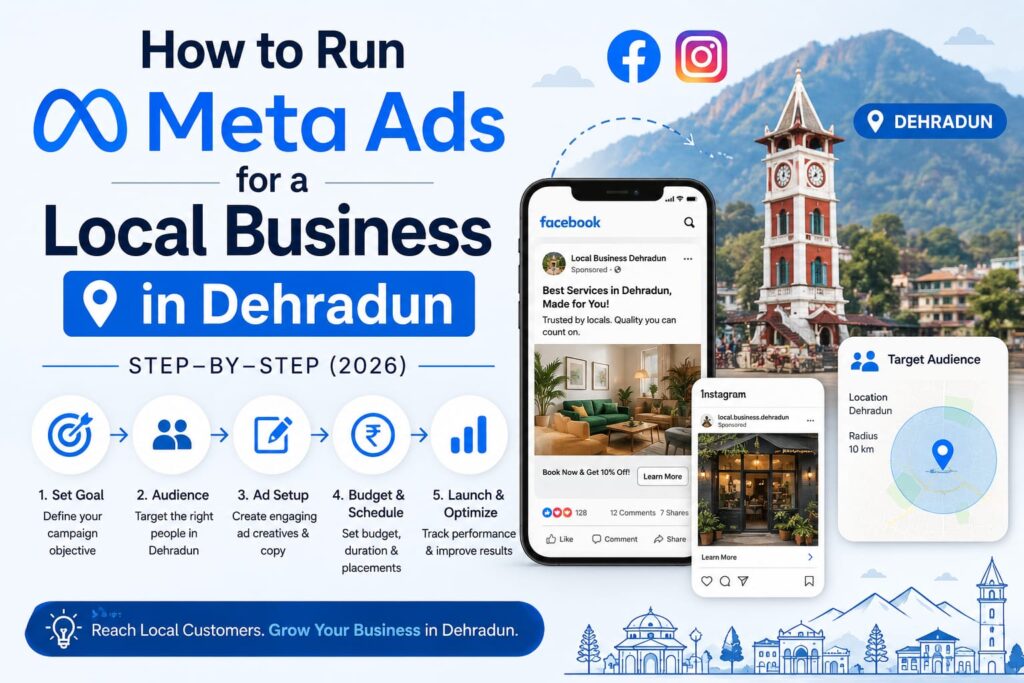
Running paid advertising as a small business owner in Uttarakhand has never been more accessible — and Meta Ads for a Local Business in Dehradun are one of the most cost-effective ways to reach your exact customers in 2026. Whether you own a restaurant in Rajpur Road, a boutique in Paltan Bazaar, a coaching centre in Dalanwala, or a salon near ISBT, Facebook and Instagram ads allow you to put your business in front of the right people at the right time — with budgets that actually make sense for a small Indian business. This guide is written specifically for Dehradun business owners and marketing students who want a practical, step-by-step walkthrough without the jargon of Western advertising tutorials that assume dollar budgets and foreign market behaviour.
Dehradun is a city with a rapidly growing digital consumer base. Smartphone penetration is high, Instagram usage among the 18–40 age group is significant, and local discovery — finding a new café, gym, or service provider — increasingly happens through social media rather than word of mouth alone. This means that a well-placed Meta ad, even on a modest budget of ₹500 per day, can generate real enquiries, footfall, and sales for a Dehradun business. The challenge is knowing how to set up that ad correctly — because a poorly structured campaign wastes every rupee, while a well-structured one compounds its returns over time.
This step-by-step guide covers everything from creating your Meta Ads account and choosing the right campaign objective, to targeting the right neighbourhoods in Dehradun, designing creatives that convert, and reading your results without confusion. By the end, you will know exactly what to do — and what to avoid — when running Meta ads for your local Dehradun business in 2026.
Step 1 — Setting Up Your Meta Ads Account
Before you run a single ad, you need the right foundation. Many business owners in Dehradun make the mistake of boosting posts directly from their Instagram or Facebook page — this is not the same as running a proper ad campaign, and it gives you almost no control over targeting, bidding, or results tracking.
The correct starting point is Meta Business Suite (business.facebook.com). Here is how to set it up:
Create a Meta Business Account: Go to business.facebook.com and sign in with your personal Facebook account. Create a new Business Account and enter your business name, email, and business details. This is your central dashboard for all advertising activity.
Add Your Facebook Page and Instagram Account: Connect your existing Facebook Business Page. If you have an Instagram account for your business, connect that too. Both can run ads from the same dashboard.
Set Up Meta Ads Manager: Inside Business Suite, navigate to Ads Manager. This is where all campaigns are built and managed. It is more powerful than the basic “Boost Post” button and gives you full control.
Add a Payment Method: Go to Billing settings and add your payment method. For Indian business owners, UPI, debit cards, credit cards, and net banking are all accepted. Meta charges in Indian Rupees (INR) for accounts set up in India, which simplifies budgeting significantly.
Install the Meta Pixel: This is a small piece of code placed on your website (if you have one) that tracks visitor behaviour — what pages they visit, whether they fill a contact form, or whether they make a purchase. Even if you are not running a website-focused campaign right now, installing the Pixel early means you start building audience data from day one. Ask your website developer to install it, or use a plugin if your site runs on WordPress.
Once these five steps are complete, your account is ready. Do not skip the Pixel installation — it becomes increasingly valuable as your advertising matures.
Step 2 — Choosing the Right Campaign Objective
Meta Ads Manager asks you to choose a campaign objective before anything else. This choice determines how Meta’s algorithm optimises your ads — who it shows them to, when, and in what format. Choosing the wrong objective is one of the most common and costly mistakes local businesses make.
Here are the objectives most relevant for a Dehradun local business in 2026:
Awareness: Use this if your goal is to make as many people as possible aware that your business exists. It is useful for new businesses launching in Dehradun or for promoting a new branch or service. It does not drive direct action — it builds recognition.
Traffic: Use this if you want to send people to your website or a specific landing page. Good for coaching centres or service businesses that want people to read more before enquiring.
Engagement: Use this to get more likes, comments, shares, and saves on your posts. It builds social proof but does not directly generate leads or sales.
Leads: This is the most useful objective for most Dehradun local businesses. It opens a pre-filled form inside Facebook or Instagram — the user taps, their name and number are already filled in, and they submit in seconds. You receive their contact details and can follow up directly. Perfect for salons, coaching centres, real estate agents, gyms, and any service-based business.
Sales: Use this if you have an e-commerce store and want people to make a direct purchase. Requires the Pixel to be properly installed and configured.
For most small businesses in Dehradun starting out with Meta ads, the Leads objective is the right choice. It is simple, direct, and works well even with modest budgets.
Step 3 — Audience Targeting for Dehradun and Uttarakhand
This is where Meta ads become genuinely powerful for local businesses — and where Indian targeting nuances matter most. Western tutorials will tell you to target by interest and demographic, which is correct, but they rarely explain how to handle Indian city targeting, which behaves differently from targeting in the US or UK.
Location Targeting: In Ads Manager, go to the Audience section and set your location. Type “Dehradun” and select it. You will see an option to target people who live in, were recently in, or are travelling to Dehradun. For a local business, select “People who live in this location” — this filters out tourists and travellers who are not your core customers.
You can also use the radius targeting feature. Drop a pin on your exact business location and set a radius — 3 km, 5 km, or 10 km depending on how far your customers are realistically willing to travel. A restaurant near Clock Tower might target a 3 km radius; a coaching institute might target all of Dehradun city.
Neighbourhood-Level Targeting: Meta allows you to target specific areas within Dehradun — Rajpur Road, Clement Town, Prem Nagar, Raipur, and so on. If your business serves a specific locality, use this to avoid spending budget on people in areas unlikely to visit you.
Age and Gender: Set these based on your actual customer profile. A women’s clothing boutique might target women aged 18–45. A sports coaching academy might target parents aged 28–45 with children. Be specific — broad targeting wastes budget.
Interest Targeting: Layer on relevant interests. A gym in Dehradun might target people interested in fitness, health, and yoga. A bakery might target people interested in food, cafes, and cooking. Keep interest targeting relevant but not over-narrow.
Language: Set language to Hindi and English both — Dehradun’s audience is bilingual and scrolls in both languages.
Avoid the common mistake of making your audience too large. A Dehradun business targeting “all of India” or “all of Uttarakhand” without cause is burning money on people who will never visit. Keep it local, keep it relevant.
Step 4 — Setting Your Budget (₹500/Day Framework)
For a small business in Dehradun, a starting daily budget of ₹500 is realistic and sufficient to generate meaningful data and initial results. Here is how to think about it:
Daily vs Lifetime Budget: For a local campaign with no fixed end date, use a daily budget. Set it at ₹500/day. Meta will spend up to this amount each day and optimise delivery over time.
Campaign Duration: Run your first campaign for at least 7 days without making changes. Meta’s algorithm needs 3–5 days to exit the “learning phase” — the period during which it is still figuring out who responds to your ad. Stopping a campaign before this phase completes means you never see its real potential.
Budget Scaling: If after 7–10 days your campaign is generating leads or results at a cost you are happy with, increase the budget gradually — no more than 20–25% at a time. Sudden large budget increases reset the learning phase.
Cost Per Lead Benchmark for Dehradun: Depending on the industry, a reasonable cost per lead for a Dehradun local business on Meta ads ranges from ₹30 to ₹150. A gym or coaching centre might expect leads in the ₹50–₹100 range. A real estate business might see higher costs (₹200–₹500) but with higher conversion value per lead.
At ₹500/day, you can realistically generate 5–15 leads per day depending on your industry and creative quality — which for most local Dehradun businesses is a meaningful volume to work with.
Step 5 — Creative Best Practices for the Dehradun Market
Your ad creative — the image or video paired with your ad copy — is the single biggest factor in whether your campaign succeeds or fails. The best targeting in the world cannot save a weak creative.
Use Local Visuals: Show your actual business, your actual location, your actual team. A café on Rajpur Road should show its interior, its food, and ideally a recognisable Dehradun backdrop if possible. Local visuals build immediate recognition and trust with a Dehradun audience.
Hindi and English Copy: Write your ad copy in Hinglish — a natural mix of Hindi and English that mirrors how Dehradun’s audience actually communicates. “Abhi join karo — limited seats available!” performs better than a purely formal English headline for many local business categories.
Video Over Static Images: Short videos (15–30 seconds) consistently outperform static images on Meta in 2026. A quick walkthrough of your salon, a 20-second reel of your food being plated, or a testimonial from a happy customer shot on a smartphone — all of these outperform a designed graphic with text overlay.
Clear Call to Action: Every ad must have one clear action for the viewer to take. “Call Now,” “Send Message,” “Get Free Consultation,” “Book Your Slot” — pick one and make it the centre of your ad copy. Do not confuse people with multiple options.
Offer-Led Ads: Dehradun audiences respond well to offers and urgency. “First month free,” “₹499 trial class,” “limited offer for Dehradun residents” — these hooks increase click-through rates significantly. Make the offer genuine and the urgency real.
Step 6 — Understanding Digital Marketing for Local Businesses in Dehradun
Running Meta ads effectively is one component of a broader strategy. Digital Marketing for Local Businesses in Dehradun encompasses your Google presence, your social media content, your WhatsApp follow-up process, and your reputation management — all working together. Meta ads generate the lead; your follow-up process converts it. Many Dehradun businesses run technically decent ads but lose leads because no one calls back within 24 hours. Build a follow-up system before you scale your ad spend.
This is also why many business owners and aspiring marketers in Dehradun choose to learn these skills formally rather than piecing them together from YouTube tutorials. A structured program covers not just how to run ads, but how to connect ad strategy to business outcomes.
Step 7 — Reading Your Results in Ads Manager
Once your campaign has been running for at least 5–7 days, it is time to read your results. Here are the key metrics to focus on:
Reach and Impressions: Reach is the number of unique people who saw your ad. Impressions is the total number of times it was shown (one person can see it multiple times). For a local Dehradun campaign, a reach of 5,000–20,000 per week on a ₹500/day budget is reasonable.
Click-Through Rate (CTR): This is the percentage of people who saw your ad and clicked on it. A CTR above 1% is healthy for a local campaign. Below 0.5% usually signals a creative or copy problem.
Cost Per Result: This is the most important number. If your objective is Leads, this tells you how much each lead cost you. Track this weekly and aim to reduce it over time through creative testing.
Frequency: This tells you how many times on average each person has seen your ad. Once frequency crosses 3–4, your audience has seen it enough — either expand your audience or refresh your creative.
Lead Quality: Meta Ads Manager tells you how many leads you received, but it cannot tell you if those leads converted into customers. Track this manually — call every lead, note the outcome, and calculate your actual cost per customer, not just cost per lead.
Step 8 — When to Combine Meta Ads with Google Ads
Meta ads are excellent for demand generation — showing your business to people who were not actively searching for it but match your customer profile. For capturing people who are already searching — “best salon in Dehradun,” “coaching institute near me” — Google Ads in Dehradun is the complementary tool. The two platforms work best together: Meta builds awareness and generates interest, Google captures it at the moment of active search intent. For a business with a budget of ₹1,000/day or more, splitting spend between both platforms is a strategy worth considering.
Step 9 — Common Mistakes to Avoid
Boosting posts instead of using Ads Manager: Boosted posts are limited in targeting and optimisation. Always use Ads Manager for serious campaigns.
Targeting too broadly: “All of India” or “Uttarakhand” for a local Dehradun business wastes budget. Keep targeting tight and local.
Changing the campaign too soon: Do not edit a campaign in its first 3–5 days. Let it exit the learning phase before judging performance.
Ignoring mobile creative specs: Over 90% of Meta ad views in India happen on mobile. Design all creatives for vertical (9:16) or square (1:1) format. Horizontal images designed for desktop look poor on mobile.
No follow-up system: Generating leads without a follow-up process is like pouring water into a bucket with holes. Call every lead within an hour of receiving it — this dramatically increases conversion rates.
Running only one creative: Always test at least two creatives against each other. Let data tell you which one performs better, then invest more in the winner.
Step 10 — Learning Meta Ads Properly
If this step-by-step guide has made you realise how much nuance is involved in running Meta ads effectively, you are right. There is a significant difference between running an ad and running a profitable ad. For business owners who want to manage this in-house, and for marketing students who want to offer this as a service, formal training accelerates the learning curve dramatically.
A Digital Marketing Course in Dehradun at an institute like Hashtag covers Meta ads as part of a broader curriculum — including live campaign management, real budget experience, and feedback from working professionals. Rather than learning from trial and error with your own business budget, you learn in a structured environment and apply skills with guidance. This is particularly valuable for getting Meta ads right from the start.
Conclusion
Meta ads for a local business in Dehradun are not complicated when approached step by step — but they do require the right setup, the right targeting, and the right creative to deliver real results. From building your Business Manager account to reading your cost per lead at the end of week one, every step in this guide has been written with the Dehradun market, rupee budgets, and Indian audience behaviour in mind. Follow the process, give your campaigns enough time to learn, and treat your results as data rather than judgement — and you will see your local business grow through paid social in 2026.
The businesses in Dehradun that win with Meta ads are not necessarily the ones with the biggest budgets. They are the ones that understand their audience, test their creatives, follow up on every lead, and keep improving. Whether you are a business owner managing your own ads or a marketing student building this as a career skill, the fundamentals in this guide give you a genuine foundation to work from. Start with ₹500 a day, stay consistent, and let the data guide every decision you make going forward.
About the Author
Rohan Joshi is a director and digital marketing trainer at Hashtag Academy who believes in building skills through real-world application. With 8+ years of experience working across education, healthcare, and service industries, he helps students and businesses understand how digital strategies actually perform in live markets. His mission is to create confident professionals who can deliver measurable growth.