
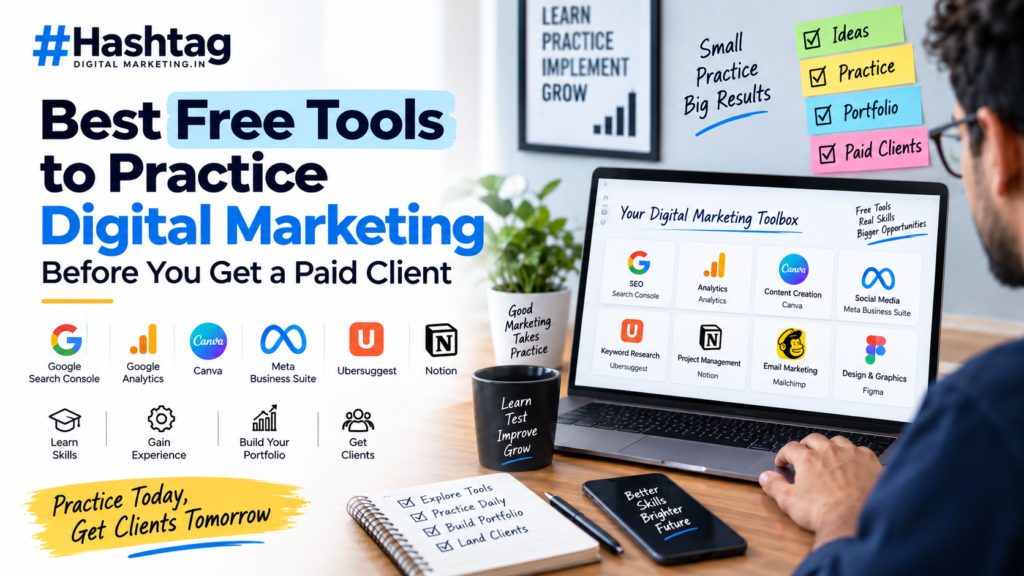
Getting your first paid digital marketing client rarely happens because of a certificate alone. Clients and recruiters want proof that you can actually run a campaign, read data, and fix what isn’t working. That’s exactly why the best free tools to practice digital marketing before you get a paid client matter so much for anyone starting out in 2026 — they let you build real, demonstrable experience without spending a single rupee.
Most beginners make the mistake of finishing a course and then waiting for the “right opportunity” to apply their skills. In reality, the gap between learning and earning is closed by hands-on practice. Running a mock Google Ads campaign, optimising a dummy website for search engines, or managing a sample Instagram page teaches you more in two weeks than another month of passive learning ever will.
This guide breaks down genuinely free tools across SEO, social media, analytics, design, and paid advertising, along with how to turn that practice into a portfolio recruiters and clients actually respect. Whether you’re a student, a career switcher, or someone who just completed a digital marketing course, this is your practical starting point.
Why Practising for Free Actually Matters
Employers and clients increasingly ask a simple question during interviews: “Can you show me something you’ve done?” A resume line saying you “know SEO” carries far less weight than a screenshot of a keyword ranking you improved, even on a personal blog.
Practising with free tools also builds three things that formal education alone cannot:
- Comfort with real dashboards, not just theory
- A body of work you can screenshot, document, and share
- The confidence to speak about results, not definitions, in interviews
This hands-on approach is also how AI-driven hiring and screening tools increasingly evaluate candidates — by scanning for evidence of applied skills rather than keyword-stuffed resumes. Practical experience, even unpaid, is what search engines and hiring algorithms alike now reward.
Free SEO Tools to Learn Search Optimisation
Search engine optimisation is one of the most in-demand digital marketing skills, and thankfully, some of the most powerful tools in this space are free to use.
Google Search Console – Lets you track how a website performs in Google search, monitor indexing issues, and see which queries bring traffic. Ideal for practising on a personal blog or a friend’s small business site.
Ubersuggest (free tier) – Useful for basic keyword research, content ideas, and competitor analysis without any payment.
AnswerThePublic – Shows real questions people search around a topic, helping you understand search intent, a core skill for both traditional SEO and modern AI-driven search results.
Yoast SEO or Rank Math (WordPress plugins) – Free versions help you practise on-page optimisation like meta titles, headings, and readability.
A simple project idea: start a free WordPress or Blogger site, write five optimised articles, and track their performance using Search Console. This single exercise teaches keyword targeting, on-page SEO, and basic reporting — three things almost every entry-level job description asks for.
Free Social Media Marketing Tools
Social media management is often the easiest place to start because most platforms are free to use natively.
- Meta Business Suite – Manage and schedule posts for Facebook and Instagram pages, and access basic performance insights, all without spending anything.
- Buffer (free plan) – Lets you schedule a limited number of posts across platforms, useful for learning content calendars.
- Canva (free plan) – Not just a design tool; it’s where most beginners learn to create scroll-stopping social creatives, reels covers, and carousel posts.
- Later (free plan) – Good for practising Instagram-specific scheduling and grid planning.
Create a practice page — for a fictional brand, a local shop willing to let you help, or even a personal passion project — and post consistently for 30 days. Document the growth in followers, engagement rate, and reach. This becomes a strong talking point for a digital marketing internship interview.
Free Analytics and Performance Tools
Data literacy separates marketers who can only “post content” from those who can actually explain why a campaign worked or failed.
Google Analytics 4 (GA4) – The industry standard for website traffic analysis. Learning GA4 dashboards, audience reports, and conversion tracking is non-negotiable in 2026.
Google Looker Studio – Free tool to build visual reports from GA4 or ad data, useful for presenting results the way agencies do.
Meta Ads Manager Insights – Even without running paid ads, the reporting interface can be explored on free demo or test accounts to understand metrics like CTR, CPC, and ROAS.
Try this exercise: connect Google Analytics to your practice blog or website, and after a month, create a one-page Looker Studio report summarising traffic sources and top-performing pages. This is precisely the kind of applied analysis that separates candidates who completed a digital marketing certification from those who can genuinely use one.
Free Tools to Practice Paid Advertising
Paid advertising intimidates most beginners because it involves real money — but you can still learn the mechanics for free.
- Google Ads Skillshop – Google’s own free certification platform lets you complete courses and take practice exams on Search, Display, and Shopping ads, along with mock campaign setup.
- Meta Blueprint – Meta’s free learning platform for Facebook and Instagram advertising, including certification exams.
- Google Ads Editor – A free desktop tool where you can build and structure entire campaigns (ad groups, keywords, budgets) without ever publishing or spending money.
Building a mock campaign structure in Google Ads Editor and explaining your targeting logic in an interview shows initiative that most freshers skip entirely.
Free Email Marketing and Automation Tools
Email marketing still delivers strong ROI, and beginners often overlook it in favour of social media.
- Mailchimp (free plan) – Allows you to design, send, and track email campaigns to a small list, perfect for learning subject line testing and automation basics.
- MailerLite (free plan) – A simpler alternative with drag-and-drop email building, ideal for practising newsletter design.
Set up a free newsletter around a topic you’re passionate about, send weekly updates, and track open and click rates. This small project demonstrates copywriting, automation setup, and performance tracking in one go.
How to Turn Free Practice Into a Portfolio
Tools alone won’t get you hired — how you present your practice does. Here’s how to structure it:
- Create a simple Google Drive or Notion page documenting each project
- Include screenshots of before-and-after metrics, not just final numbers
- Write a short summary explaining your strategy, what worked, and what you’d improve
- Group work by skill: SEO, social media, paid ads, email, and analytics
This becomes your digital marketing portfolio, and it’s often more persuasive in interviews than a certificate alone. Many hiring managers at agencies and even in-house teams now specifically ask candidates to walk through a project rather than recite theory, which makes a documented portfolio essential rather than optional.
Common Mistakes Beginners Make While Practising for Free
Even motivated learners fall into a few avoidable traps:
- Practising randomly without setting a measurable goal for each project
- Switching tools too often instead of mastering two or three deeply
- Not tracking results, so there’s nothing concrete to show later
- Treating free practice as “just for learning” instead of real portfolio material
Avoiding these mistakes is often what separates someone who finishes a digital marketing training institute programme and lands a role quickly from someone who struggles for months afterward.
When You’re Ready to Move From Practice to Paid Clients
Once you have two to three documented projects with real, even if small, results, you’re in a strong position to pitch for paid work. Start with:
- Local businesses in your city who lack any online presence
- Family-run shops needing help with Google My Business or social pages
- Small e-commerce sellers who need basic SEO or ad account setup
Charging even a modest fee for your first project validates your skills far more than another certificate. Many successful freelance digital marketer journeys in India begin exactly this way — free practice, a documented portfolio, then a small paid project that snowballs into referrals.
Frequently Asked Questions
Are free digital marketing tools enough to learn practical skills, or do I need paid software?
Free tools are more than sufficient for building foundational, job-ready skills. Paid tools like SEMrush or HubSpot offer more advanced features, but most beginner and even intermediate-level tasks can be learned and demonstrated using free versions.
How long should I practise before applying for a job or client work?
Most learners see meaningful results within 60 to 90 days of consistent practice, especially when working on two or three focused projects rather than spreading effort thin across many platforms.
Do recruiters actually check portfolios built with free tools?
Yes. Recruiters and agency owners increasingly prioritise applied experience over certificates alone. A well-documented portfolio, even from unpaid practice, often carries more weight than a course completion certificate on its own.
Which free tool should a complete beginner start with first?
Start with Google Analytics and Google Search Console if you’re leaning towards SEO and data, or Canva and Meta Business Suite if you’re more interested in social media and content creation.
Can free tools alone prepare me for a digital marketing internship?
They can prepare you significantly, especially when paired with structured learning. Combining free-tool practice with a proper digital marketing course or certification programme gives you both the theoretical grounding and the practical proof employers look for.
Final Thoughts
Learning digital marketing theory is only half the journey. The other half is proving you can apply it — and that proof comes from hands-on practice with real tools, not just course completion. Start small, document everything, and let your free-tool projects speak louder than your resume.
If you’re serious about turning these skills into a career, structured guidance can shorten the learning curve significantly. Explore the digital marketing courses at Hashtag Digital Marketing to get expert mentorship, live projects, and placement support that takes you from practice to your first paid client, faster.
Ready to stop practising and start earning? Join Hashtag Academy expert-led course today, build a real portfolio, and land your first paid client with confidence.